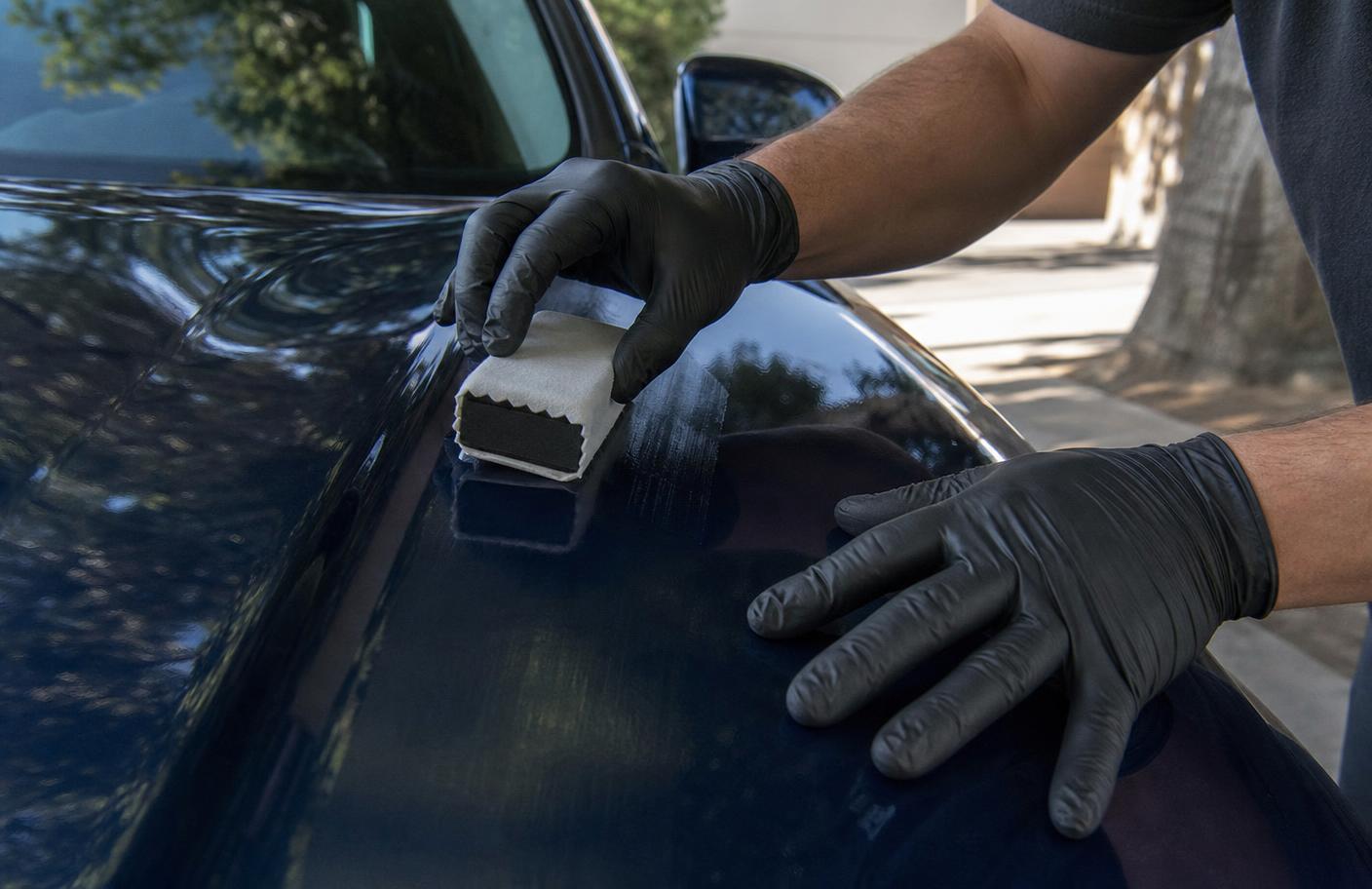
Mobile ceramic coating in Los Angeles
We bring water, power, lighting and the full polishing setup to you. Coatings need a controlled surface — dry, dust-free, and out of direct sun — so we work inside garages, subterranean parking structures, and shaded carports whenever possible. If your parking situation is tight, tell us the layout when you request an estimate and we'll tell you honestly whether it will work.
Most coating jobs are a full-day appointment because the prep, not the coating itself, is where the result comes from. A rushed coating over unprepared paint looks impressive for a week and disappointing for years, which is why we spend most of the appointment on the surface underneath.
Work happens across the city and the Valley, from garaged weekend cars to daily drivers that live on the street. If you want the broader picture of how we operate, the mobile detailing Los Angeles overview covers the service area and how appointments run.
What ceramic coating actually is
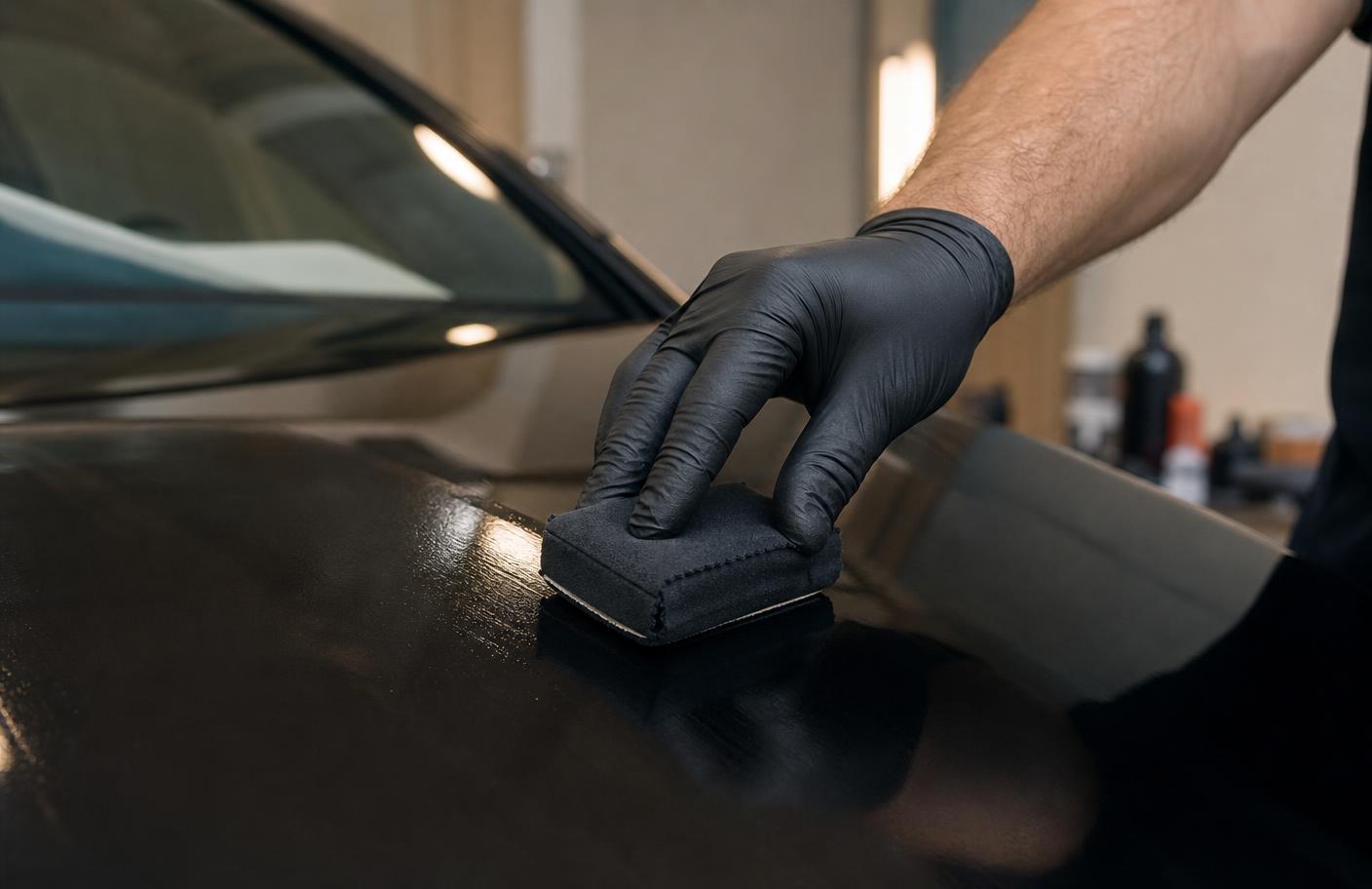
In plain English: a ceramic coating is a liquid applied by hand to properly prepared automotive surfaces. Once spread and leveled, it cures — first to the touch within minutes, then progressively harder over the following days — and bonds to the clear coat rather than sitting loosely on top of it the way a wax does.
What you end up with is a thin, hard, sacrificial surface. Road film, dust and fallout land on the coating instead of directly on your clear coat, and because that surface is slicker and more chemically resistant than bare paint, contamination tends to release more easily during a normal wash.
The other visible change is water behavior. A coated panel is strongly hydrophobic: water pulls into tight beads and rolls off rather than spreading into a film. That is the party trick people notice first, but the practical value is that less water and less dirt stay on the panel between washes.
Gloss usually improves too, though it is worth being precise about why. The coating adds clarity and depth to a surface that has already been polished properly. It does not fill or hide defects — it seals in whatever the paint looked like on the day it was applied.
Compared with traditional protection, the difference is durability and chemistry. Wax is a soft, short-lived film that washes and heats away. Sealants are synthetic and last longer. A coating is a harder cured layer with meaningfully better chemical resistance and a longer service life — provided the paint was prepared correctly and the car is maintained sensibly afterwards.
What ceramic coating does for your vehicle
Hydrophobic behavior
The cured surface has very low surface energy, so water cannot spread out and cling. It contracts into beads and sheets off the panel as you rinse or drive. Less standing water means less opportunity for minerals and road film to dry onto the paint in the first place.
Easier washing
Dirt, dust and light road film bond less aggressively to a slick coated surface than to bare clear coat. In practice, that usually means a shorter wash with less scrubbing — which is the single biggest factor in keeping a finish free of new wash marring.
Chemical resistance
Bird droppings, tree sap, bug residue and general acidic grime are the everyday enemies of clear coat in Los Angeles. A coating adds resistance and buys you more time to remove them safely. It is not immunity — anything acidic left baking on a hot panel can still cause damage.
UV and environmental resistance
The coating acts as a sacrificial barrier that takes some of the environmental load instead of your clear coat. It helps, and it is one reason coated cars parked outdoors tend to hold their finish better — but no coating blocks all UV or stops paint from ageing.
Gloss and clarity
Because the coating is applied to freshly polished, oil-free paint, reflections read cleaner and colors look deeper. Dark colors gain visible depth; metallics show more flake separation. The gloss comes from the prep as much as from the product.
Less aggressive maintenance contact
This one is often overstated, so we will be exact: a coating does not prevent scratches. What it does is reduce how much contact and pressure a normal wash requires, and most swirl marks on a modern car come from washing. Safer washing means fewer new defects over time.
What ceramic coating does not do
Most disappointment with coatings comes from expectations set by marketing rather than by the product. Here is the honest list of what a ceramic coating will not do for your car.
- It will not stop rock chips from freeway gravel or construction debris
- It will not prevent dents, parking-lot dings or shopping-cart damage
- It will not stop key scratches or deep scratches that reach past the clear coat
- It does not make paint indestructible or scratch proof
- It does not eliminate washing — a coated car still gets dirty
- It does not make the surface water-spot proof
- It will not repair oxidation, clear-coat failure or existing scratches
- It is not a substitute for paint correction, and it cannot hide defects
- It will not keep a vehicle permanently clean
The useful distinction is between chemical and environmental protection — which a coating provides well — and physical impact protection, which is a different category of product entirely. Paint protection film is the product designed for rock-chip and impact resistance; it is not part of our mobile service, so if that is your main goal we would rather tell you now than sell you the wrong thing.
Why ceramic coating makes sense in Los Angeles
Sun and UV exposure
Vehicles parked outside anywhere in Southern California take sustained UV exposure, and it lands hardest on horizontal panels — the hood, roof, and trunk or rear deck. Those are the surfaces that fade, dull and oxidize first on an unprotected car. A coating gives those panels a resistant sacrificial layer instead of leaving bare clear coat exposed all day.
Coastal exposure
Cars that live around Malibu, Santa Monica, Venice, Manhattan Beach, Hermosa Beach and Redondo Beach pick up salt-laden marine air along with the usual grit. That residue is easier to rinse off a slick coated surface than off bare paint. To be clear: a paint coating makes routine cleaning easier — it is not a corrosion treatment and does not protect underbody metal.
Freeway and urban contamination
Heavy freeway miles mean road film, brake dust, tire particulate and airborne industrial fallout, all of which bond into clear coat over time. Cars near industrial corridors and rail lines collect more of it. A coating reduces how aggressively that contamination sticks and makes periodic decontamination less punishing on the paint.
Cars parked outdoors
Street and lot parking in Downtown Los Angeles, Koreatown, Hollywood and Silver Lake means constant dust, construction fallout and whatever the block generates. Owners in these areas usually get the most day-to-day value from a coating, simply because maintenance washes get quicker and less abrasive.
Trees, sap and bird droppings
Jacaranda season, ficus sap and shaded street parking under mature trees are a real problem for clear coat. A coating adds chemical resistance and gives you more time to remove organic contamination safely. It does not make the vehicle immune — prompt removal still matters, especially on a hot panel in direct sun.
Neighborhood by neighborhood
A garaged car in Calabasas and a street-parked daily in Koreatown do not have the same problem. Hillside and canyon properties deal with fine dust and wind; coastal properties deal with salt and moisture; dense urban blocks deal with fallout and constant contact. We scope the job around where the car actually lives.
Our ceramic coating process
1. Decontamination wash
Two-bucket hand wash, dedicated wheel and tire cleaning, iron fallout dissolver, then a clay treatment to pull embedded rail dust and industrial fallout out of the clear coat. Anything left bonded to the paint at this stage stays trapped under the coating.
2. Paint inspection
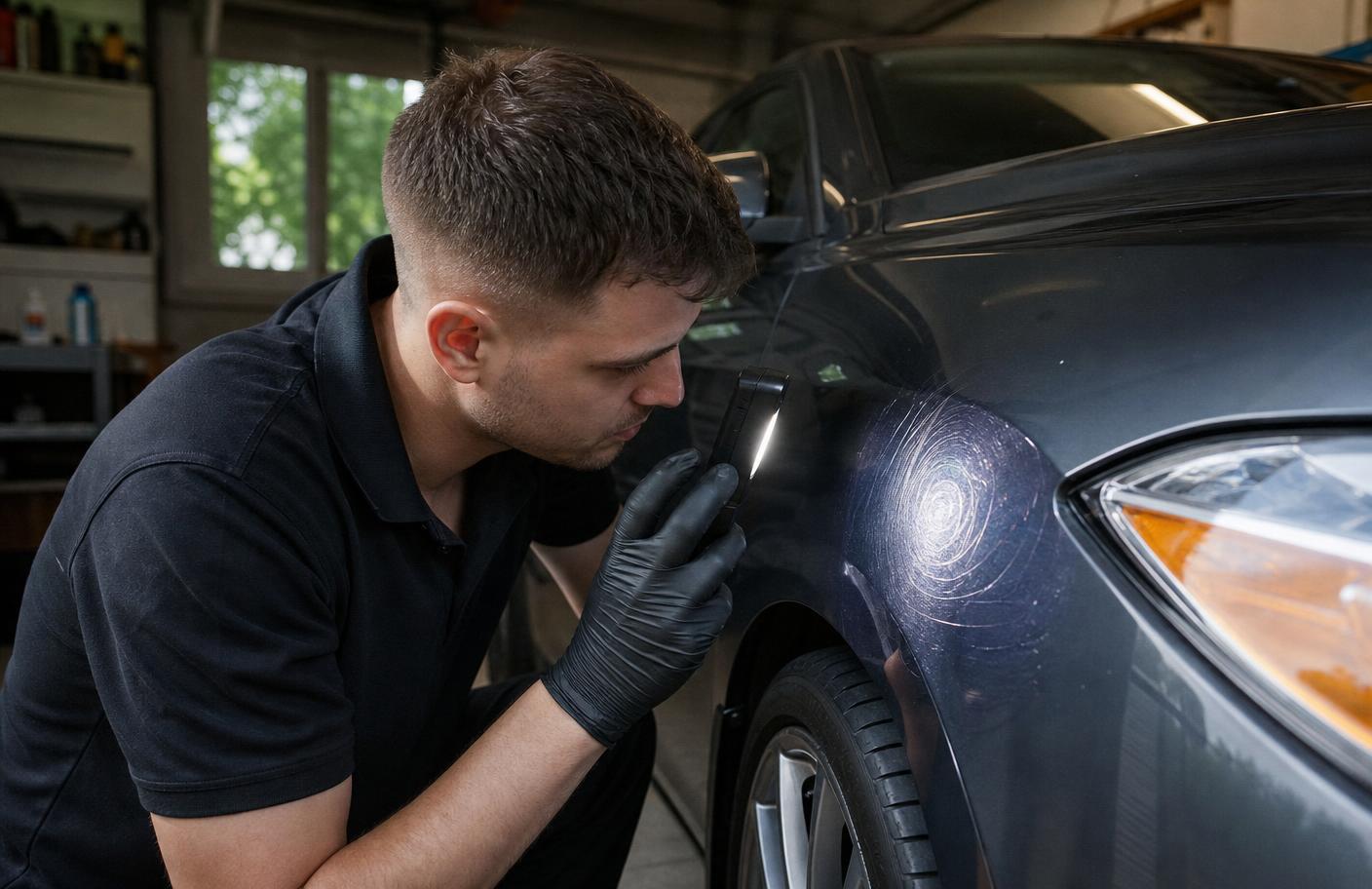
We go over the panels under focused light and tell you exactly what we see — swirls, buffer trails, water etching, sanding marks from previous body work — and what a single-stage polish versus a fuller correction would realistically achieve.
3. Machine polishing as required
Coating locks in whatever is underneath it, so defects are corrected first. Depending on condition that ranges from a one-step gloss enhancement to multi-stage paint correction. The right level is a conversation, not a fixed package.
4. Panel preparation
A solvent wipe strips polishing oils and residue so the coating bonds to bare, clean clear coat rather than to leftover lubricants. Trim, glass and rubber are masked or protected where needed. Skipping this step is one of the most common reasons a coating fails early.
5. Coating application
The product is applied by hand, panel by panel, in a controlled cross-hatch pattern so coverage is even and nothing is missed on edges or complex body lines.
6. Leveling and inspection
Each panel is leveled at the correct flash time and then checked under angled light for high spots or streaking. High spots are far easier to correct in the first minutes than after they have cured.
7. Initial cure
The coating needs a dry, stable environment while it sets. We plan the appointment around your parking situation so the vehicle can sit undisturbed for the initial cure rather than getting driven straight into a rainy night or a sprinkler zone.
8. Maintenance handover
Before we leave, we walk you through the aftercare for the specific coating installed and the wash routine that keeps it performing. Maintenance is not an afterthought — it is the difference between a coating that lasts and one that quietly stops working.
Why paint preparation matters more than the coating
The single most useful thing to understand before booking is that the coating is the last and fastest step of the job. Everything that determines the result happens before the bottle is opened.
Decontamination comes first because paint that looks clean rarely is. Iron particles from brake dust and rail dust embed themselves in clear coat and keep oxidizing. Road film, tar spots and bonded industrial fallout create a rough surface at a microscopic level. If a coating is applied over that contamination, two things happen: the finish never feels properly slick, and the coating bonds to the contamination rather than to the clear coat — which shortens its useful life.
A chemical iron treatment dissolves embedded ferrous particles, and a clay treatment shears off what is left bonded to the surface. The paint should feel glass-smooth before anything else happens. Cars that have picked up paint overspray need that addressed separately first — see overspray removal if you have a gritty finish after nearby construction or painting work.
Only once the surface is genuinely clean can we assess the paint honestly, because contamination hides defects and exaggerates others under inspection lighting.
Paint correction before ceramic coating
Ceramic coating does not hide bad paint. It seals it in, and it can even make defects more visible by adding gloss and clarity to the surface above them. If your clear coat contains swirl marks, holograms, haze, water-spot etching, oxidation, previous polishing defects or light scratches, those need to be evaluated before any coating goes on.
There is a spectrum of preparation, and honest assessment decides where your car sits on it:
- Paint in good condition: a light enhancement polish is often enough to clean up the finish and prepare it for coating
- Moderate defects: a one-step correction can remove the majority of visible swirls and restore clarity without removing much clear coat
- Heavier defects: multi-stage correction — a cutting stage followed by refining stages — is appropriate where marring, holograms or etching are established
Which level makes sense depends on paint condition, how deep the defects are, the age and history of the vehicle, the finish quality you want and how long you plan to keep the car. Read the detail on multi-stage paint correction, or tell us the vehicle, paint condition and where it parks and we'll tell you what preparation makes sense before coating.
Ceramic coating vs wax vs paint sealant
All three protect paint. They differ in how long they last, how much preparation they demand and how much commitment they represent. Durability varies by product and by how the car is stored and washed, so the comparison below is deliberately qualitative rather than a promise of a number of years.
| Traditional wax | Paint sealant | Ceramic coating | |
|---|---|---|---|
| General durability | Shorter-term — weeks to a couple of months | Intermediate — typically several months | Longer-term when properly installed and maintained |
| Ease of application | Simple, can be done at home | Simple to moderate | Technical — permanent bonding, unforgiving of mistakes |
| Prep requirements | Light — a clean surface is usually enough | Decontamination recommended | Full decontamination and correction as required |
| Hydrophobic behavior | Good initially, fades quickly | Good, fades gradually | Strong and persistent with maintenance |
| Chemical resistance | Low — removed by strong detergents and heat | Moderate | High relative to wax and sealant |
| Maintenance | Frequent reapplication | Periodic reapplication | Correct wash routine, occasional decontamination |
| Relative commitment | Low cost, low commitment | Middle ground | Higher up-front investment, longest service life |
| Ideal customer | Enjoys frequent detailing, short ownership | Wants protection without a full prep job | Keeping the car, wants easier long-term maintenance |
If a coating is more commitment than you want right now, a maintained exterior hand wash and wax is a completely reasonable alternative — and it keeps the paint in good shape if you decide to coat later.
Is ceramic coating worth it?
A coating earns its cost through years of easier maintenance and better-preserved paint, so the honest answer depends on the owner more than the vehicle.
It usually makes good sense if you plan to keep the vehicle for several years, actually care about how the paint looks, wash the car regularly, own a dark-colored finish where swirls show, park outdoors, drive enough to collect road film, want maintenance to be less work, have already invested in paint correction, own an enthusiast or premium vehicle, or simply want protection that outlasts wax.
It may not be the right call if the paint is already failing — peeling clear coat, heavy oxidation or delamination should be addressed by a body shop first. It also makes little sense if you do not intend to maintain the car at all, if you are selling or returning the vehicle shortly, if what you actually want is rock-chip protection, if the car needs body or paint repair first, or if your budget and needs are honestly better matched by a wax or sealant.
We would rather scope you into the right service than upsell a coating onto a car that will not benefit from it.
Ceramic coating for new cars
Coating a new car before it accumulates defects is a sound idea, but "new" does not automatically mean defect-free. Vehicles pick up marring long before you collect the keys: dealership washes with shared media, transport film and contamination, weeks of lot storage in the sun, improper drying, and the odd clumsy pre-delivery clean all leave marks.
That does not mean every new vehicle needs correction. Plenty of new cars need nothing more than decontamination and a light polish before coating. Some need a single-stage correction on a few panels. The point is that the paint should still be inspected under proper lighting before anything is applied, because a coating locks in whatever is there.
The upside of coating early is real: you are protecting paint at its best condition rather than trying to recover it later.
Ceramic coating for black and dark vehicles
Black, dark blue, dark grey and other deep finishes are the most rewarding cars to coat — and the least forgiving. Dark paint reflects more directly, so gloss, depth and reflection clarity are dramatically more visible after a proper job. It is also the paint on which every swirl mark, hologram and wash scratch shows in direct Los Angeles sun.
That cuts both ways. Because a coating adds clarity, defects underneath a dark coated panel become more obvious, not less. Preparation is therefore even more important on dark cars than on silver or white ones — and the reason a well-coated black car looks the way it does is good correction plus protection, not the coating hiding anything.
The maintenance benefit is significant too. Dark paint punishes careless washing, so a surface that releases dirt more easily and needs less contact directly protects the finish you paid to correct.
Ceramic coating for luxury and performance vehicles
Los Angeles has an unusual concentration of vehicles whose owners genuinely care about paint condition — luxury sedans and SUVs, sports and performance cars, enthusiast-owned weekend cars and premium daily drivers. For those owners the calculation is straightforward: they have already invested in the appearance of the car, and correction plus coating is the combination that preserves it.
It is also why correction and coating are so often booked together. Once paint has been machine-polished back to clarity, protecting it makes far more sense than leaving corrected paint bare and washing it back into the same condition over the next two years.
Garaged weekend cars and daily-driven premium vehicles need different scoping — a car that leaves the garage twice a month has very different contamination exposure to one commuting on the 405 daily — and we plan the preparation accordingly.
Living with a ceramic-coated vehicle
A coated vehicle still needs to be washed. Everything a coating does — releasing dirt easily, resisting chemicals, beading water — depends on the surface being kept reasonably clean. Left dirty for months, a coated car will look and behave like any other neglected car.
The good news is that maintenance is genuinely easier, as long as it is the right kind of maintenance.
- Wash by hand with a gentle two-bucket method and clean, dedicated wash media
- Use a pH-appropriate automotive soap rather than dish detergent or aggressive degreasers
- Dry promptly with clean microfiber or filtered air rather than letting droplets evaporate
- Avoid brush-style automatic tunnel washes entirely — they undo the finish you paid for
- Remove bird droppings and tree sap as soon as you notice them, especially on hot panels
- Manage mineral and water spotting early; dried minerals get harder to remove with time
- Have the paint decontaminated periodically if the car lives outdoors or covers heavy freeway miles
If you would rather not maintain it yourself, we run scheduled maintenance washes for coated vehicles — see exterior hand wash and wax or all detailing services.
The first days after installation
A coating cures in stages. It is dry to the touch quickly, but the surface continues to harden over the following period, and that early window is when it is most vulnerable.
The general rules are the same across products: keep the surface dry during the initial cure, do not wash the vehicle immediately, avoid unnecessary contact with the paint, and keep it away from sprinklers, rain and heavy dust while it sets.
Exact timings differ by coating system, so we do not publish a universal number here — we give you the specific aftercare instructions for the coating installed on your vehicle, along with the first-week rules, before we leave. If you are unsure about something in that first week, call us rather than guessing.
Can a ceramic coating get water spots?
Yes. This matters in Southern California more than almost anywhere, so it is worth being blunt: hydrophobic does not mean water-spot proof.
Water spots are not caused by water — they are caused by what the water leaves behind. When mineral-heavy water dries on a panel, the water evaporates and the dissolved minerals stay on the surface. A coating cannot prevent that from happening.
The usual culprits here are lawn sprinklers hitting a car parked on the street or driveway, washing with hard tap water, and droplets drying in strong direct sun before they can be dried off. Heat accelerates the whole problem, which is why a car rinsed at noon in July spots faster than the same car rinsed at 8am.
What a coating does help with is removal. Mineral deposits sit on a slick, chemically resistant surface rather than etching straight into clear coat, so they can usually be dealt with more easily and with less aggressive work. Left long enough in the sun, minerals can still etch a coated surface — prompt drying is the real fix.
Can ceramic coating be applied at my Los Angeles home or garage?
Usually yes, and that is the point of a mobile service — but not every parking situation is suitable, and it is better to establish that before booking rather than on the day.
A successful mobile coating needs shade, because direct sun makes the product flash far too quickly to level properly. It needs a genuinely dry surface and a stable environment during the initial cure. It needs reasonable dust control, which is why enclosed garages and subterranean parking structures work so well and why breezy hillside or beach-adjacent driveways on a windy afternoon often do not.
Practically, we also need working clearance around the vehicle — roughly enough space to walk and work on all four sides — plus safe access for power and lighting. Shared subterranean garages usually work well if building management allows the work and there is room to open doors fully.
Situations that often need a rethink: uncovered street parking in full sun, extremely tight tandem spaces, active construction dust nearby, and open driveways during windy conditions. Tell us the address and describe the space when you request an estimate, and we will tell you honestly whether the environment supports a coating or whether a different service is the better use of your money.
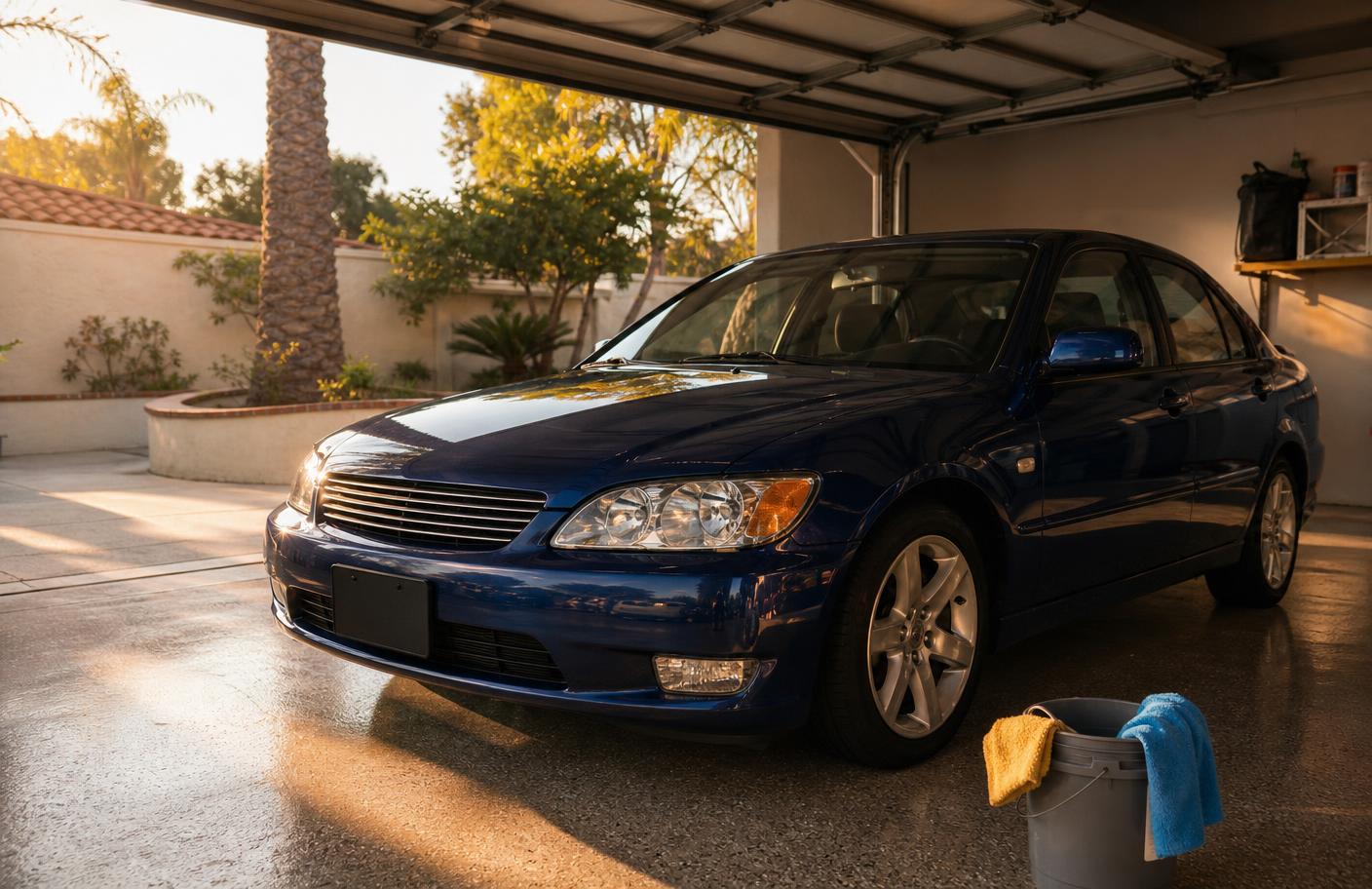
Ceramic paint protection across Los Angeles
A car parked outdoors in Koreatown or Downtown collects a very different mix of grime than a garaged weekend car in Calabasas. Street parkers benefit most from the easier-cleaning side of a coating; coastal drivers in Malibu, Venice and Manhattan Beach benefit most from the chemical resistance against salt-laden air.
In Beverly Hills most of the work is garage-based on luxury vehicles that see limited mileage but high expectations for finish quality. Malibu and PCH-adjacent cars deal with constant marine air and sun. Santa Monica mixes coastal exposure with dense street and structure parking. Calabasas is largely garaged hillside residential, where fine dust and wind are the main considerations. Downtown Los Angeles is parking structures, urban fallout and cars that rarely get a break from contamination.
If your paint is already heavily marred, the honest sequence is multi-stage paint correction first, coating second. We'd rather tell you that up front than coat over defects you'll notice for the next three years.
Premium Ceramic Coating across Los Angeles neighborhoods
This service is booked most often in the areas below, where local conditions make it especially worthwhile.
- Ceramic Coating in Beverly HillsGarage-based detailing for luxury vehicles between Rodeo Drive and the flats.
- Ceramic Coating in MalibuCoastal-specific protection for cars living along PCH and the canyons.
- Ceramic Coating in Santa MonicaSalt-air paint care for cars parked between Ocean Avenue and the 10.
- Ceramic Coating in CalabasasGated-community and hillside homes served at the garage, off Calabasas Road.
- Ceramic Coating in Downtown Los AngelesLow-water service inside DTLA residential and office parking structures.
Premium Ceramic Coating FAQs
Related services
- Multi-Stage Paint CorrectionMachine polishing that removes swirls, holograms and light scratches instead of hiding them under filler.
- Exterior Hand Wash & WaxA careful two-bucket hand wash, wheels and tires done properly, and a wax or sealant that actually lasts.
- Overspray RemovalPaint, stucco and industrial overspray safely lifted off paint, glass and trim without damaging the finish.
Back to all detailing services or the mobile detailing Los Angeles overview.