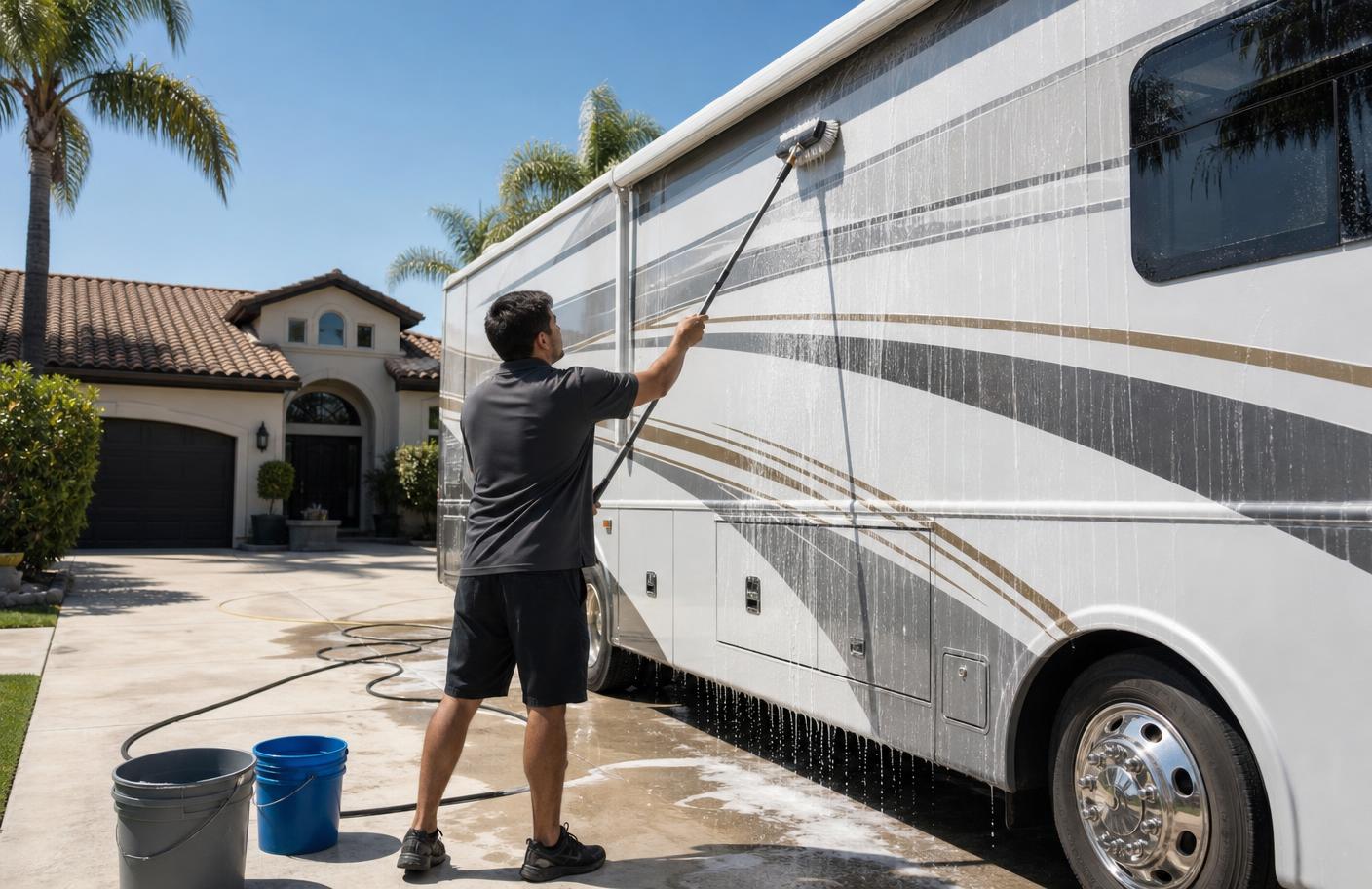
Mobile RV detailing across Los Angeles
An RV is the vehicle that benefits most from mobile service, simply because moving it is the hardest part. Work happens where the coach lives: a residential driveway, private property, a commercial yard, or an RV storage facility that permits outside vendors.
What we need is straightforward — enough clearance to walk and work around the coach, a safe surface to set ladders on, and permission from whoever controls the property. We cannot work at every location, and we would rather tell you that before scheduling than after arriving.
If you want the wider picture of how appointments run, the mobile detailing Los Angeles overview covers the service area and how we schedule.
- Residential driveways with room to walk both sides of the coach
- Private property and suitable commercial lots
- RV storage facilities that allow outside detailing vendors
- Locations with adequate overhead and side clearance for ladder work
Why RV detailing is not car detailing on a bigger scale
The obvious difference is surface area. A single sidewall on a Class A coach can exceed the entire painted area of a sedan, and there are two of them, plus a front cap, a rear cap, a roofline and a lower skirt. Time and water use scale accordingly.
The less obvious difference is materials. A car is essentially one surface — clear coat over paint — with some trim and glass. An RV is a patchwork: fiberglass and gel coat over much of the body, painted panels on higher-end coaches, large vinyl decals, aluminum on some trailers, rubber seals around every window and hatch, textured plastic trim, awning fabric and hardware, and heavy steel or aluminum wheels.
Those surfaces do not tolerate the same chemistry. A cleaner strong enough to strip heavy oxidation staining can dull or lift decal edges. A degreaser that is fine on a lower skirt is a poor choice near seals. This is why blanket-treating an entire coach with one aggressive product, or blasting it with high pressure, is bad practice — pressure driven into a seal, a decal edge or a window frame causes problems that cost far more than the wash.
The working approach is controlled and top-down: soften contamination first, clean in manageable sections so nothing dries mid-process, match the product to the surface in front of you, and use mechanical agitation only where it is actually needed.
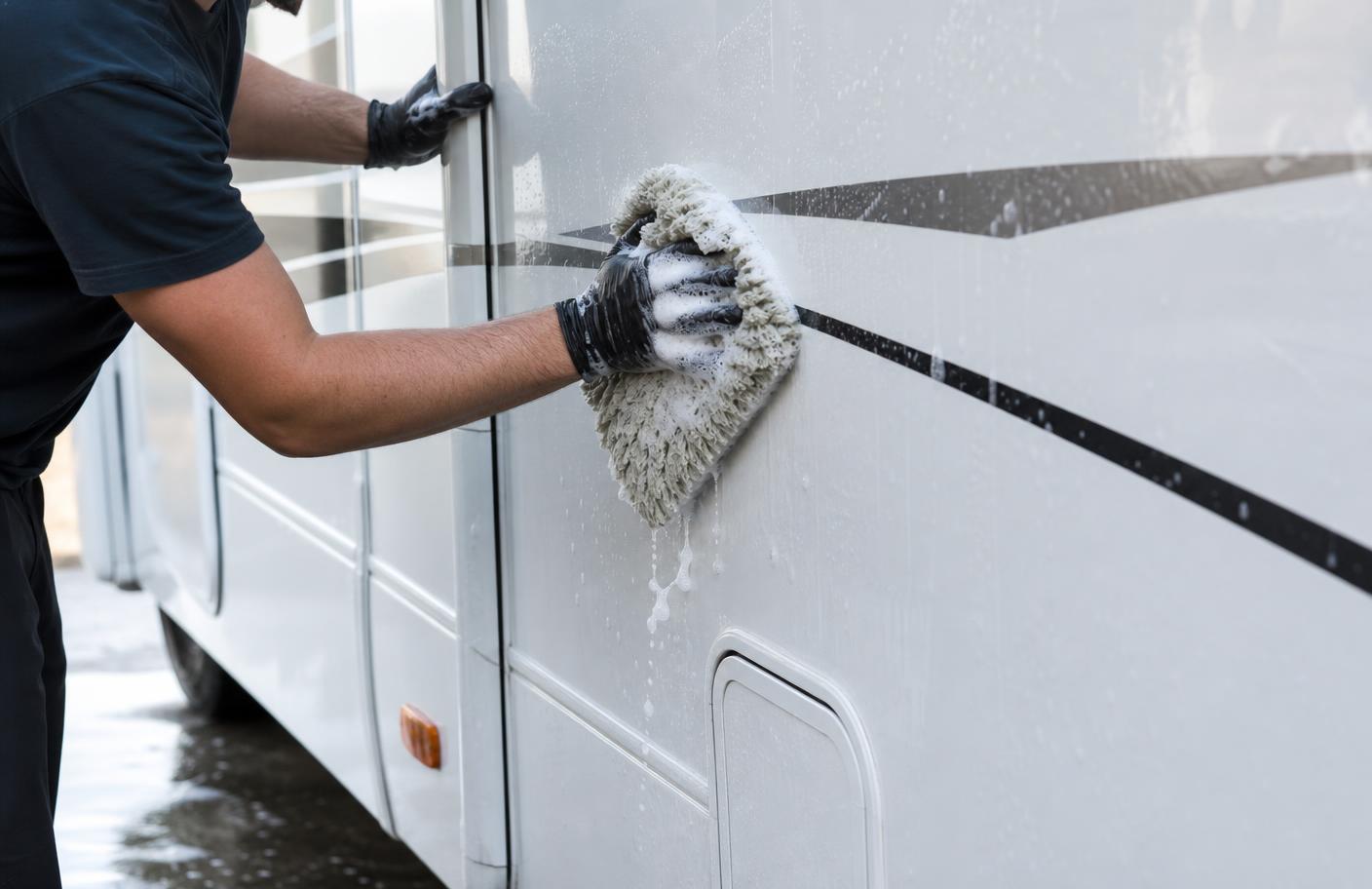
What Los Angeles does to an RV exterior
Sun and UV load
Most RVs in Los Angeles live outdoors, and an outdoor coach presents an enormous surface to year-round Southern California sun. Over time that shows up as fading, chalky oxidation on gel coat, dulling of exterior plastics, ageing and edge-lifting on decals, and a general loss of gloss — worst on roof-facing surfaces and the sun-facing side of the coach.
Coastal air
Coaches kept nearer the water — Santa Monica, Venice, Malibu, the South Bay — collect salt-laden moisture and a persistent coastal film that keeps redepositing between washes. It builds on glass and horizontal surfaces faster than inland dust does.
Freeway and road contamination
A long trip up the 5 or out through the desert leaves a front cap plastered with insect residue and a lower body coated in road film, brake dust and tire residue. On a light-coloured coach that grime reads as a grey band along the bottom third that ordinary rinsing will not touch.
Storage dust and standing time
Many RVs are used a few times a year and sit the rest of it. Windblown dust settles into every trim gap and seal, accumulates along the roofline, and then runs down the sides with the first dew or rain — which is where black streaking begins.
Hard water and mineral spotting
Sprinkler overspray on a driveway-parked coach, or water left to dry on a hot sidewall, leaves mineral deposits across an enormous panel and every window. Prevention is mostly about how the RV is dried; established spotting is a separate discussion, and our water spot and mineral removal approach on paint is not identical to what is appropriate on gel coat.
What an RV exterior wash involves
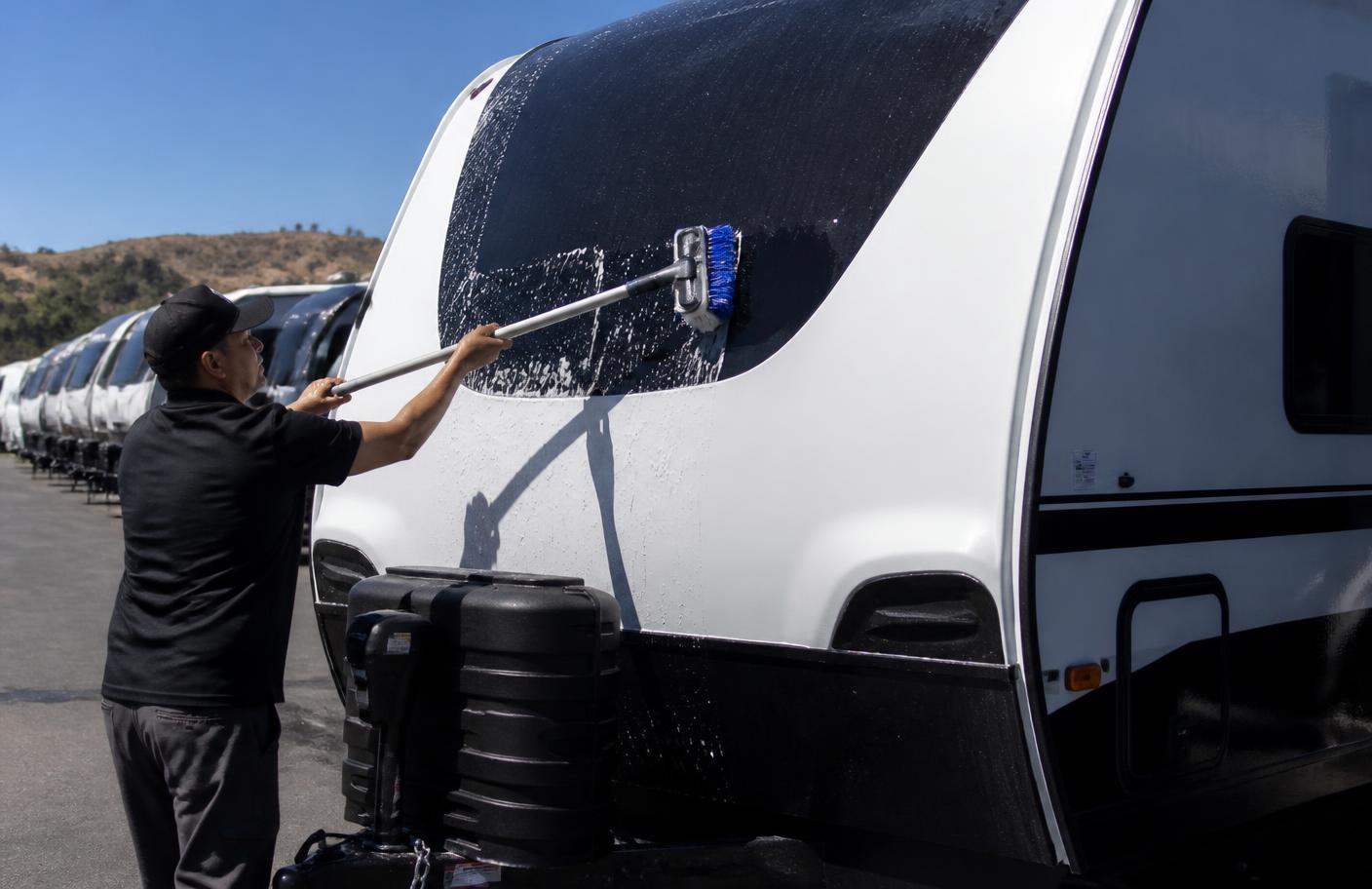
A proper RV wash is methodical rather than fast. Work runs top-down so runoff never contaminates a section already cleaned, and in panels small enough that nothing dries before it is rinsed.
- Pre-rinse and softening of dust, bug residue and road film
- Front cap treatment, where insect residue is chemically softened rather than scrubbed off
- Sidewall washing section by section with RV-appropriate cleaners
- Targeted black streak treatment where the surface and the staining allow it
- Careful cleaning around decals, graphics, seals and trim edges
- Windows and glass, inside frames and channels where reachable
- Wheels, tires and the lower skirt where road film concentrates
- Controlled drying to limit mineral spotting on large flat surfaces
Not sure what your coach needs? Send photos and the length with your request and we'll scope it honestly. Call (213) 340-0749 or request an estimate.
Black streaks, bugs and road film
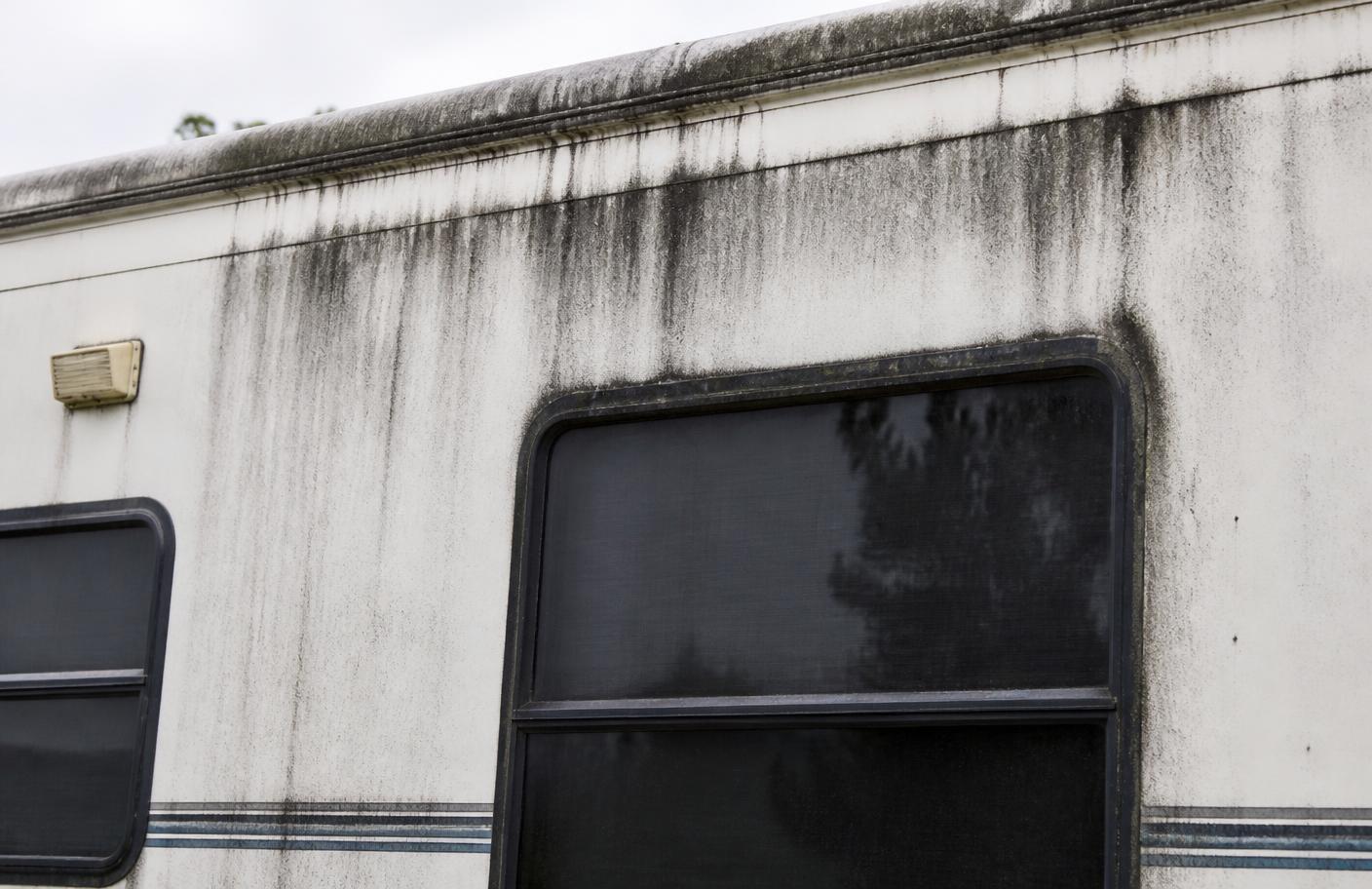
Black streaking is the single most common complaint we hear about RVs, and it is a runoff problem. Water carries dirt, roof sealant residue and oxidation off the roof edge and down the sidewalls, concentrating around awning rails, window frames, trim edges and drainage points. Left to bake in the sun it stops being surface dirt and starts staining the gel coat itself.
Light and moderate streaking usually responds well to a dedicated streak remover with dwell time and gentle agitation. Long-standing streaking on chalky or oxidised gel coat is a different matter — some of the discolouration is in the surface, not on it, and a wash will improve it rather than erase it. We will tell you which situation your coach is in before starting.
Insect residue on a front cap is acidic and can etch if it sits through a Southern California summer. The correct approach is to soften and dissolve it with dwell time and repeat applications, not to attack it with pressure or aggressive pads — heavy scrubbing on a cap is how you dull the finish and damage decal edges.
Road film along the lower panels and rear surfaces is a mix of oil, brake dust and rubber. It needs a dedicated cleaner and contact time, and it is normally the dirtiest and slowest part of the job.
Oxidation and sun damage: dirty is not the same as degraded
This distinction matters more on RVs than on cars, and it is where most disappointment comes from. A wash removes contamination sitting on the surface. It does not restore a surface that has broken down.
Oxidised gel coat feels chalky and leaves a white residue on your hand. Faded decals crack and lift at the edges. Degraded plastics turn grey and slightly rough. None of that is dirt, and no amount of washing changes it — the coach will simply be a clean version of the same condition.
Heavy gel coat restoration and full decal replacement are specialist RV bodywork jobs we do not represent as part of a mobile wash. Where a coach has painted panels rather than gel coat, some of the same principles that apply to automotive finishes can be relevant — our multi-stage paint correction page explains how machine work on paint actually functions — but those procedures do not transfer identically to every RV surface, and we assess before promising anything.
Practically: we will tell you what a thorough clean will realistically achieve on your coach, and where the remaining appearance issue is condition rather than contamination.
RV wax and exterior protection
Protection is optional and worth discussing once the surface is clean, because it only makes sense on surfaces in reasonable condition. Applied to sound gel coat or paint, a wax or sealant acts as a sacrificial layer: contamination bonds less aggressively, the next wash takes less contact, gloss improves, and the surface takes some of the environmental load instead of the substrate.
What it does not do is stop UV damage permanently. Protection slows things down and has to be renewed; it does not make an outdoor-stored coach immune to Southern California sun, and it will not bond usefully to a heavily chalked surface that is already breaking down.
Which product suits a given coach depends on its materials and condition — gel coat, painted panels and large decal areas do not all want the same treatment. If you are familiar with our exterior hand wash and wax or ceramic coating work on cars, the logic is similar, but the products and expectations for an RV surface are their own conversation and we scope them per coach.
RV wheels and tires
RV wheels collect a heavy mix of brake dust, road grime and general storage dirt, and on larger coaches there are six of them, often with polished aluminum faces that mark easily with the wrong cleaner. We clean wheels and wheel wells with products appropriate to the finish, and clean the tire sidewalls — which on an RV are large, permanently exposed and highly visible.
Cleaning is cosmetic work. We are not inspecting or assessing RV tires for age, condition or roadworthiness; that belongs with a qualified RV service shop.
Roof and upper-surface work has to be scoped
We do not promise roof cleaning sight unseen, and you should be sceptical of anyone who does. Whether upper-surface work is possible on a given coach depends on the height, the roof construction and its condition, whether that roof is designed to be walked at all, how much clearance surrounds the RV, and what the service location allows.
Some coaches have walkable reinforced roofs in good order. Some have membrane roofs where foot traffic risks damage. Some are simply parked where safe ladder placement is not possible. In many cases the practical answer is cleaning the roofline edge and upper sidewalls from a stable ladder — which is where the streaking originates anyway — rather than full roof access.
Tell us the coach height and the parking situation when you request an estimate and we will tell you what upper-surface work is realistic in your case.
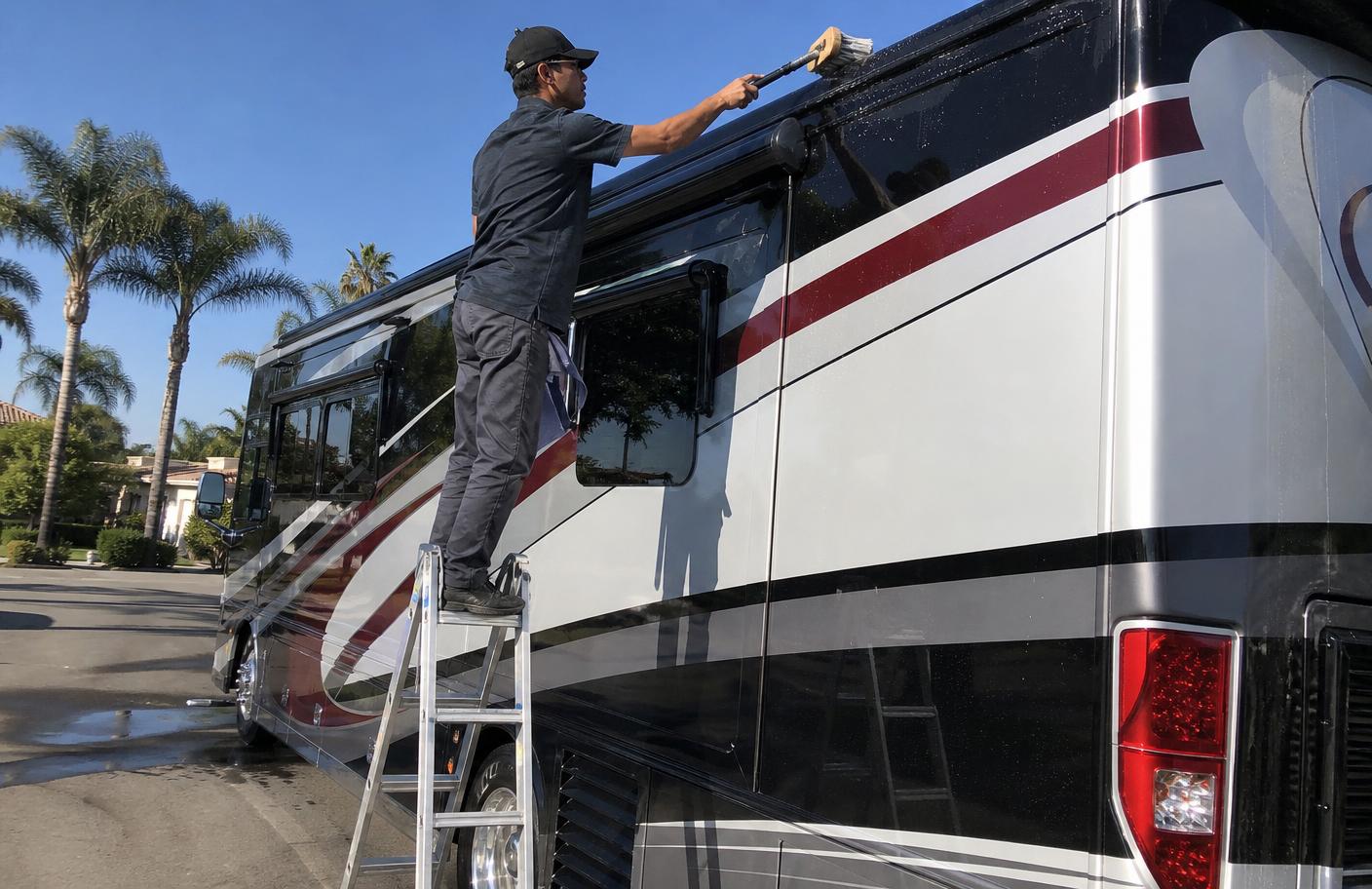
Motorhomes, travel trailers and fifth wheels
Class A motorhomes
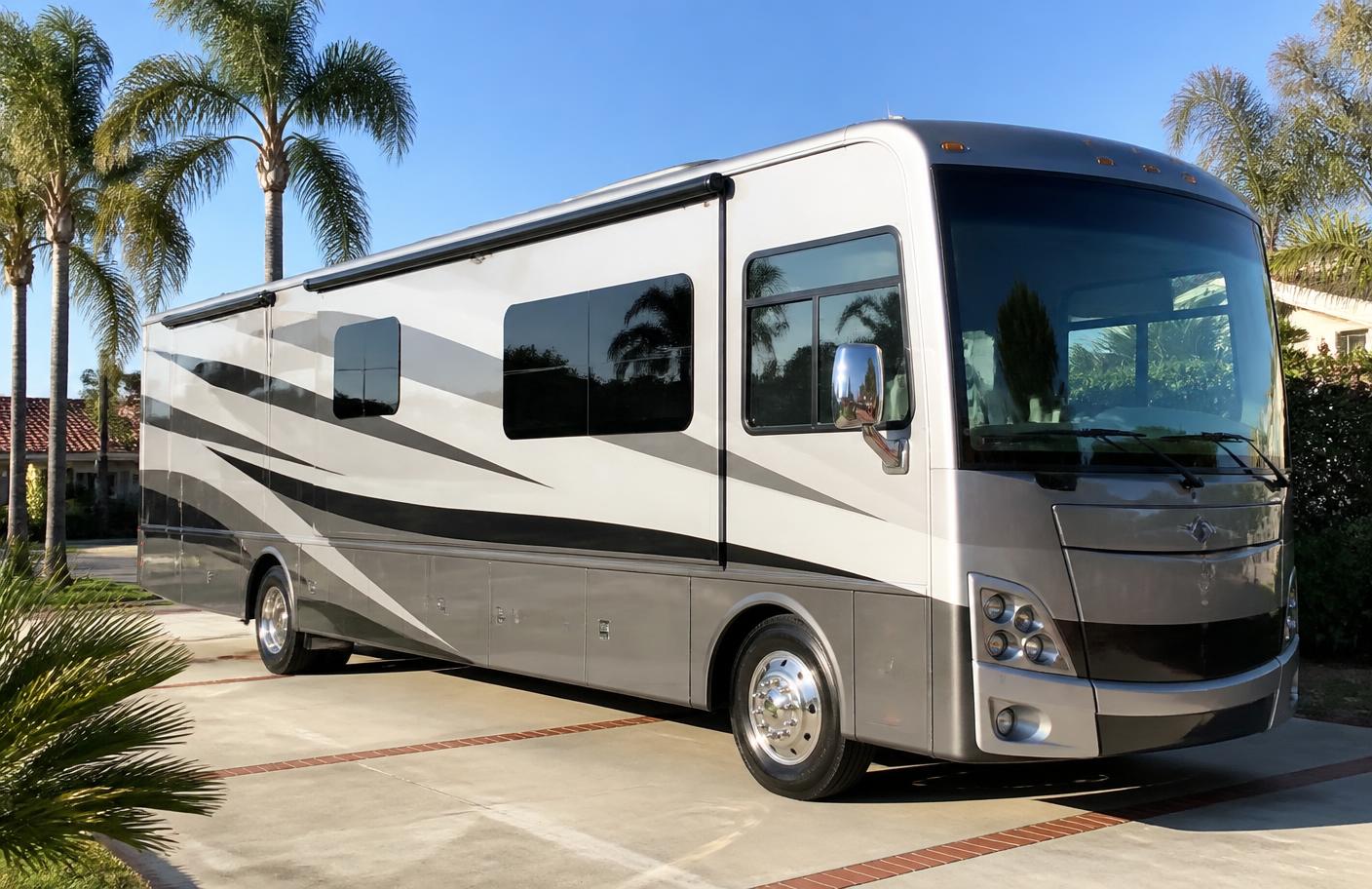
The largest job on the list: tall sidewalls, extensive glass, a large front cap that takes the full insect load, and a rear cap that collects road film. Ladder work is almost always required, and the appointment is long.
Class B camper vans
A smaller footprint and often washable from ground level, but still subject to road film, bug residue, sun exposure and outdoor-storage contamination. Frequently the quickest RV job we do.
Class C motorhomes
The cab-over section deserves particular attention — it collects contamination, sees hard sun exposure and is awkward to reach. The automotive cab up front is a different surface set from the coach body behind it.
Travel trailers
Long flat sidewalls with large decal graphics, plus the storage dust and road grime typical of a trailer that spends most of the year parked. Front caps take stone and bug damage from towing.
Fifth wheels
Tall front caps and high upper sections mean access is the limiting factor. Clearance around the coach at its parking location determines a lot about what can be reached safely.
RVs stored away from home
Plenty of Los Angeles owners have nowhere at home to keep a coach, so it lives at a storage facility. That is workable, but it comes with conditions we would rather establish before booking.
Some facilities welcome outside detailing vendors. Some prohibit any washing on site, usually because of water runoff and drainage rules. Some allow it only in a designated wash bay or on certain days. Working space between stored units varies enormously, and covered or indoor storage often has height and clearance limits that rule out ladder work entirely.
Please confirm with the facility that outside vendors are permitted, and ask what their water and runoff rules are, before we schedule. It takes one phone call and it avoids an appointment that cannot legally go ahead.
What we need to quote your RV
RV jobs vary too much to price from length alone — a well-maintained 30-foot trailer washed three months ago and a 38-foot coach that has sat outside for two years are entirely different amounts of labour. The more of the following you can tell us, the more accurate and stable the estimate will be.
- RV type — Class A, B or C motorhome, travel trailer, fifth wheel or camper van
- Approximate length, and height if you know it
- Year, make and model if handy
- Current exterior condition, honestly described
- How long since it was last professionally cleaned
- Whether black streaking, chalky oxidation or faded decals are present
- Whether you want interior work as well as exterior
- Service location and ZIP code — home, private property or storage facility
- How much clearance there is around the coach for ladders and hoses
- Whether facility permission is needed, and whether you have confirmed it
Photos help enormously — a few shots of the sidewalls, front cap and roofline let us scope the job properly. Attach the details on the estimate form or call (213) 340-0749.
What RV detailing costs in Los Angeles
We do not publish RV prices, and any figure quoted before seeing the coach is a guess dressed up as a number. What we can do is be transparent about what drives the cost, so you can judge quotes sensibly.
Labour is essentially the whole equation. Everything below either adds hours or adds risk that has to be worked around carefully.
- Coach length and height, which set the raw surface area
- Exterior condition and how long contamination has been bonded on
- Severity of black streaking and whether it responds to treatment
- Presence of oxidation, which changes what the job can achieve
- Access and clearance at the service location
- Number of wheels and how heavily contaminated they are
- Whether protection is applied after cleaning
- Interior scope, if requested
- Travel distance within the Los Angeles service area
Get an RV detailing estimate — call (213) 340-0749 or send your coach details and we'll come back with a realistic scope and price.
Maintained coaches versus neglected ones
There is a large and predictable gap between an RV washed a few times a year and one that has been sitting outside untouched since the last trip. On a maintained coach, contamination has not bonded, streaking has not stained into the gel coat, and the appointment is shorter and cheaper. On a neglected one, much of the labour goes into undoing a year of standing time — and some of it will not fully undo.
For owners who use the coach regularly or store it outdoors, periodic cleaning is simply cheaper over time than an occasional rescue job. How often depends on where the RV sits, how much sun it takes and how often it travels; a coach under cover inland needs far less than one parked outdoors near the coast. We are happy to suggest a sensible interval for your specific situation rather than sell a fixed schedule.
Where we service RVs around Los Angeles
Mobile RV work is available across appropriate parts of our Los Angeles service area, subject to travel distance, access at the location and scheduling. Driveway space is the usual limiting factor, which is why Valley and suburban addresses tend to be the easiest to serve.
Coaches in Sherman Oaks, Encino, Woodland Hills and Calabasas are often parked at home with room to work. Owners in Burbank, Glendale and Pasadena more often use nearby storage. Coastal coaches around Santa Monica, Malibu and Long Beach carry more salt film and typically need more frequent attention. Dense areas like Downtown Los Angeles and Hollywood usually mean a storage-lot appointment rather than a street one.
If you are unsure whether your location works, describe it when you get in touch — we would rather assess it up front than turn up and find there is no room to open a ladder.
Mobile RV Detailing across Los Angeles neighborhoods
This service is booked most often in the areas below, where local conditions make it especially worthwhile.
- RV Detailing in Sherman OaksValley-heat-focused paint and interior care around Ventura Boulevard.
- RV Detailing in Woodland HillsHeat- and dust-focused care for the west Valley, near Topanga Canyon Boulevard.
- RV Detailing in CalabasasGated-community and hillside homes served at the garage, off Calabasas Road.
- RV Detailing in BurbankStudio-lot and workplace detailing, plus homes around Magnolia Boulevard.
- RV Detailing in Long BeachBelmont Shore to downtown Long Beach — coastal and port-area vehicle care.
Mobile RV Detailing FAQs
Related services
- Exterior Hand Wash & WaxA careful two-bucket hand wash, wheels and tires done properly, and a wax or sealant that actually lasts.
- Fleet & Commercial Vehicle DetailingScheduled on-site cleaning for vans, trucks and company cars — done at your yard, on your timetable.
- Premium Ceramic CoatingA durable, hydrophobic layer bonded to prepped paint — easier washing and stronger defense against LA sun and fallout.
Back to all detailing services or the mobile detailing Los Angeles overview.