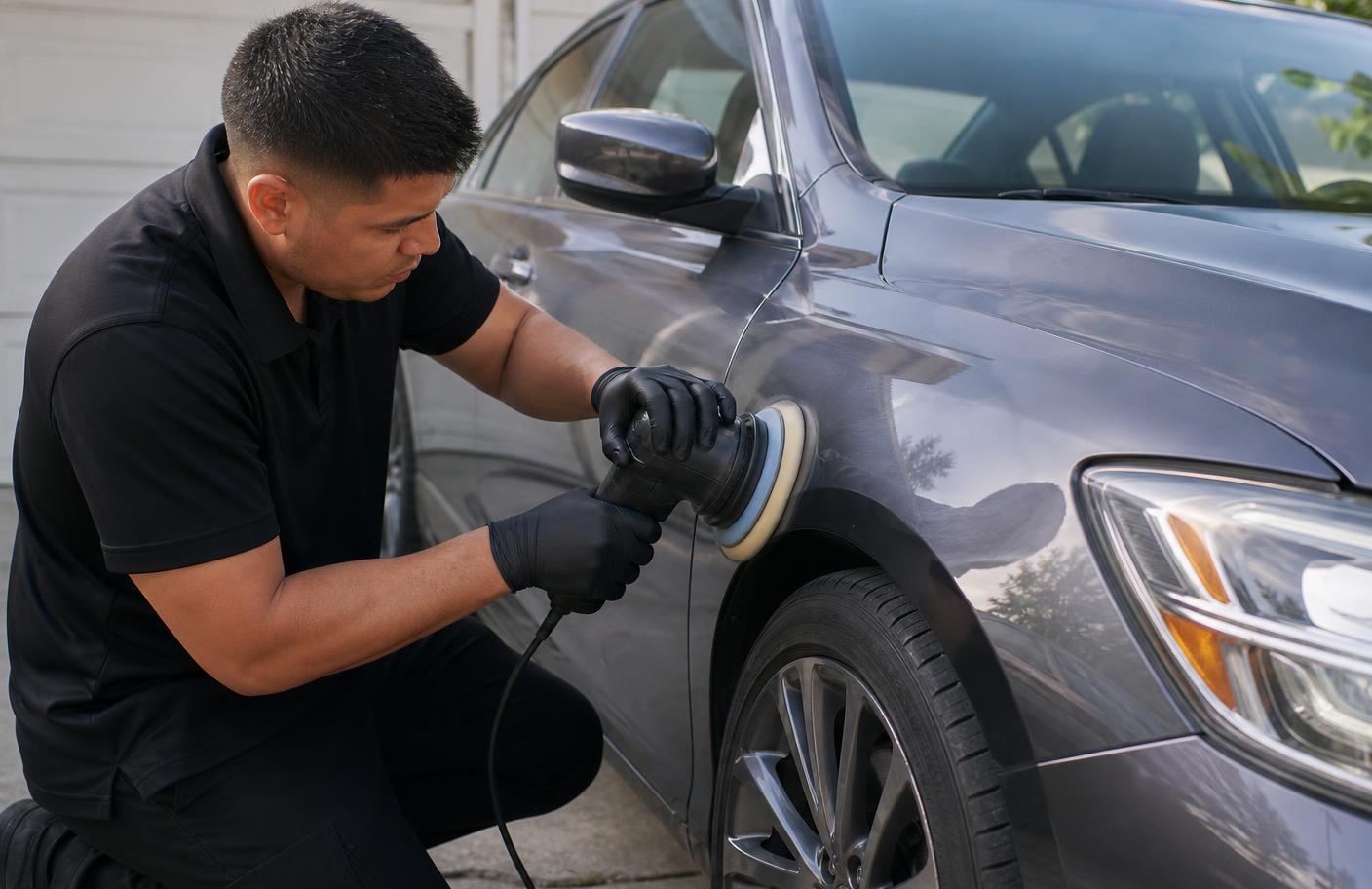
What paint correction actually is
Almost every modern vehicle wears a two-layer finish: a colored base coat, and a transparent clear coat over it that provides gloss and UV resistance. Essentially all of the defects people want removed live in that clear layer, not in the color underneath.
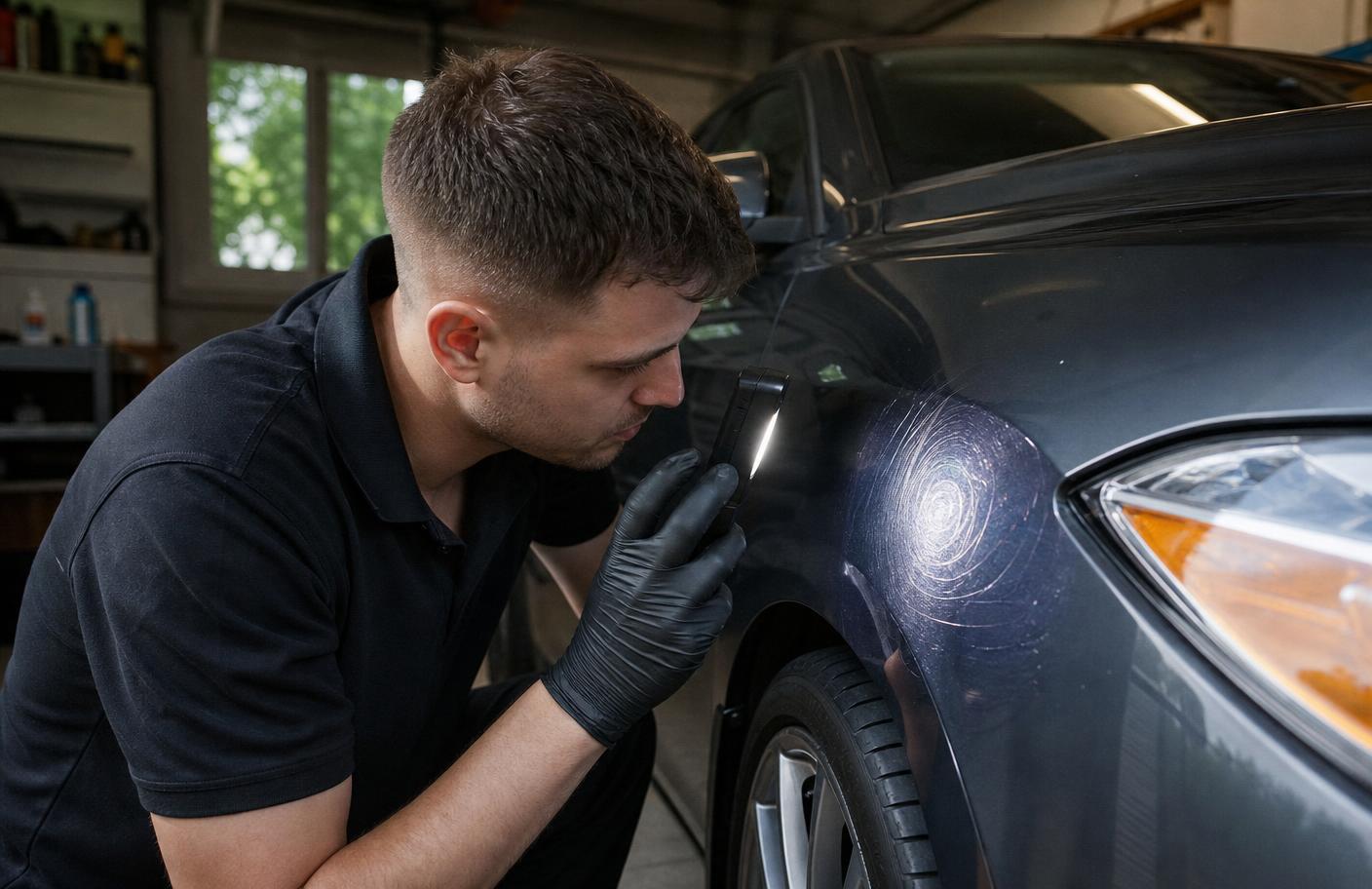
Those defects are microscopic scratches and depressions. When light hits an undamaged panel it reflects back in one direction, so reflections look sharp and the color looks deep. When the surface is covered in thousands of fine scratches, light scatters in every direction — that is what you see as swirl marks in sunlight, as haze on a grey day, and as a general loss of depth in dark colors.
The usual cast of defects includes swirl marks and spiderwebbing from wash contact, wash marring from dirty media, holograms and buffer trails from careless rotary polishing, water-spot etching where minerals have bitten into the surface, oxidation and dullness on sun-baked horizontal panels, and light scratches that have not reached through the clear.
Correction works by leveling. A machine polisher, a foam or microfiber pad and an abrasive polish remove a very small amount of clear coat across the surface — measured in microns — until the surrounding paint sits level with the bottom of the scratch. There is nothing left to scatter light, so clarity and gloss come back.
This is the key distinction: correction removes or reduces defects by leveling the paint. It does not fill or mask them with temporary oils, glazes or fillers that wash away in a few weeks. That also means correction is finite — clear coat is not renewable, which is why the process is deliberately conservative.
What causes paint defects in Los Angeles
None of these causes are unique to Los Angeles, but the combination of them here explains the condition we find on most vehicles we inspect.
Washing — the biggest single cause
Brush-style automatic washes drag grit from the previous hundred cars across your paint. Single-bucket hand washing puts the same grit back on the mitt. Dirty or reused drying towels finish the job. The overwhelming majority of swirl marks we correct were installed during washing and drying, not by the road.
Urban dust and freeway contamination
Cars that cover freeway miles collect road film, brake dust and airborne industrial fallout. Ferrous particles embed in the clear coat and keep oxidizing. Wiping a dusty car dry — the classic quick wipe-down before leaving the house — grinds that grit straight into the surface.
Coastal air
Vehicles around the beach cities pick up salt-laden marine air along with fine sand. Sand is abrasive, and it turns an otherwise careful wash into a scratching exercise if the surface is not properly pre-rinsed.
Sprinklers and hard water
Lawn sprinkler overspray on a street-parked or driveway-parked car is one of the most common causes of mineral spotting we see. Water evaporates, dissolved minerals stay behind, and if the panel is hot or the deposit sits long enough it can etch into the clear coat.
Sun and outdoor parking
Sustained UV exposure oxidizes and dulls unprotected paint, and it lands hardest on hoods, roofs and rear decks. A car that lives outdoors year round typically shows far more dullness on horizontal panels than on its doors.
Trees, sap and bird droppings
Shaded street parking under mature trees is a mixed blessing. Sap and droppings are acidic, and on a hot panel they can etch into the clear coat within a day or two. Etching is exactly the kind of defect polishing can often improve — if it has not gone too deep.
Frequency of contact
A street-parked daily driver gets dirty faster, so it gets washed more often, so it accumulates wash marring faster. More contact with the paint means more defects, which is why the same car parked in a garage usually looks years younger.
What multi-stage paint correction can remove
How much of any given defect comes out depends on the vehicle in front of us, not on the package name. Defect depth is the first factor — a shallow swirl levels easily, a deeper scratch may only be softened. Paint hardness matters: some clear coats cut quickly, others resist heavily. Overall paint condition, repaint history, remaining paint thickness, whether the car has been corrected before, and simple age all move the outcome.
For that reason we do not publish guaranteed removal percentages. After the test section we can tell you what this specific paint is doing and what level of improvement is realistically available, and you decide from there.
Defects that have gone through the clear coat into the base or primer cannot be polished out at all. We will say so rather than burn clear coat chasing them.
- Swirl marks and spiderwebbing from automatic car washes, dirty mitts and drying towels
- Holograms and buffer trails left behind by careless rotary polishing
- Wash marring — the fine, uniform haze that dulls the whole vehicle
- Light to moderate scratches that have not broken through the clear coat
- Water-spot etching from sprinklers and hard water, where the etch is shallow enough
- Oxidation and dullness on sun-exposed horizontal panels
- Light sanding marks and some orange peel texture, where paint thickness and repaint history allow
What paint correction cannot fix
This matters as much as the list above. Paint correction is a finishing process, not a repair process, and there are conditions it genuinely cannot address:
- Rock chips and any area where paint is missing
- Deep scratches that have gone through the clear coat into base or primer
- Dents, creases and parking-lot damage
- Peeling, delaminating or cracked clear coat
- Paint that is actively failing rather than simply dull
- Rust, whether surface or structural
- Collision and body damage of any kind
All of those need body and paint work rather than detailing. If we see any of them during inspection we will tell you before starting, because polishing over failing paint can accelerate the failure. Send us photos with your estimate request and we can usually flag it in advance.
Our paint correction process
The sequence is consistent; the execution is not. A soft-paint Japanese daily driver, a hard-clear German sedan and a resprayed classic all get different pad and polish combinations, different numbers of passes and different levels of caution. Any shop that runs an identical process on every vehicle is guessing.
1. Decontamination wash
Polishing a dirty panel drags grit under the pad and creates new defects while removing old ones. Every correction starts with a careful two-bucket hand wash, wheels and shuts included.
2. Chemical decontamination
An iron fallout dissolver breaks down embedded brake dust and rail dust that a wash cannot touch, and tar is removed separately. These particles sit proud of the surface and would otherwise be dragged around by the pad.
3. Clay or mechanical decontamination where needed
If the surface still feels rough after chemical decontamination, a clay treatment shears off what remains bonded to the clear coat. Not every car needs it — a well-maintained, recently decontaminated finish often does not.
4. Paint inspection
We go over every panel with focused inspection lighting from multiple angles and identify what is actually there: swirls, holograms, etching, sanding marks, previous polishing damage. Defect type dictates the approach far more than defect quantity does.
5. Paint thickness and risk assessment where applicable
Readings across the panels help identify unusual thickness patterns, thin areas, inconsistencies and possible repaint history. They are a useful risk-management tool, not a certainty — readings cannot tell us the exact clear-coat layer on every panel of every vehicle, so we treat them as one input alongside inspection and the test section.
6. Test section
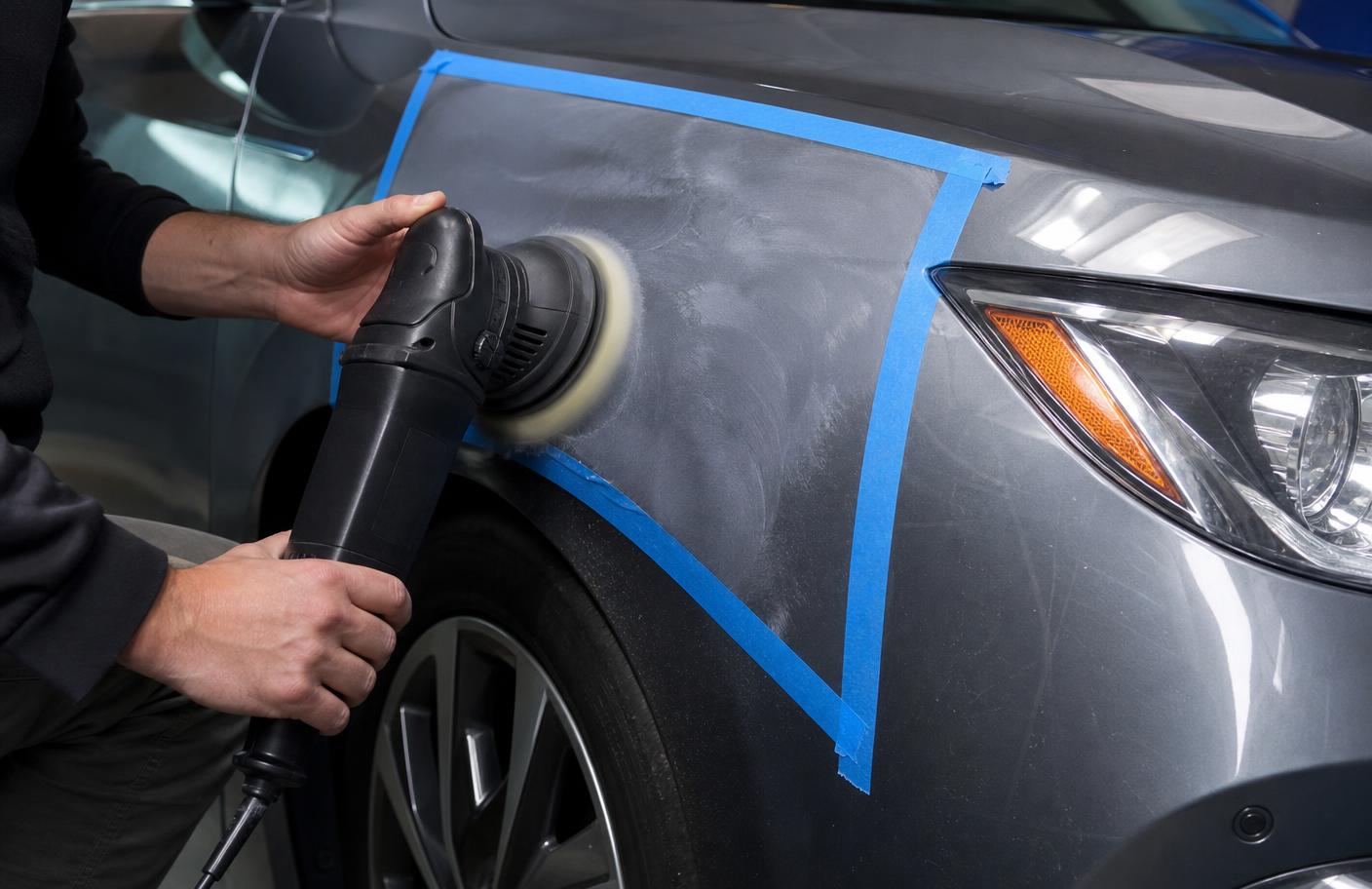
One taped-off section gets the proposed pad and polish combination so we can see how this specific paint responds before committing the whole car. We show you the before and after side by side.
7. Cutting stage
The correction pass itself: the most effective combination that the test section supports, worked section by section with consistent pressure and overlap. Edges, body lines and thin high points are treated with extra caution or worked by hand.
8. Refining stage
Cutting leaves its own micro-marring behind, particularly on soft paint. A refining pass with a finer polish and softer pad removes it and brings up final clarity. On dark or soft finishes a further jeweling pass is sometimes worthwhile.
9. Final inspection
Panels are wiped down with a residue remover so nothing is hidden by polishing oils, then re-inspected under multiple light sources. Anything that needs another pass gets one before protection goes on.
10. Protection
Freshly polished clear coat is bare. We finish with a sealant, or pair the correction with a ceramic coating to protect the result — see the section on correction before coating below.
Why the test section matters
The test section is the most important twenty minutes of the job, and it is the step most often skipped.
Different paints behave completely differently under a machine. Hard clear coats resist cutting and may need a more aggressive pad and polish combination, or more passes, to move the same defect. Soft clear coats correct quickly but micro-mar easily, so an aggressive approach creates as much new haze as it removes. Some paints finish down beautifully with a single combination; others require a distinct refining stage to look right.
By taping off a small area and working it properly, we learn how fast this paint corrects, how it finishes, whether micro-marring is a problem, which pad and polish pairing performs best, and how many passes are actually required.
The goal is to establish the least aggressive process capable of producing the improvement you want. That protects the paint, removes less material than a one-size-fits-all approach, and leaves more clear coat available for the future — including for any correction the car might need years from now.
How far should paint correction go?
There is a point on every vehicle where continuing to chase defects costs more clear coat than the visual gain is worth. Understanding that point is the difference between good correction and reckless correction.
Shallow defects — the majority of swirl marks and wash marring on most cars — level safely and completely. Deeper defects behave differently: each additional pass removes more material for a progressively smaller visual return, and the last stubborn scratch on a panel may sit deep enough that removing it entirely would take an unreasonable amount of the clear coat protecting the whole panel.
Edges, body lines, spoiler tips and sharp creases hold less paint than flat surfaces and heat up faster, so they are always treated more conservatively — often by hand. Vehicles that have already been corrected once have less material in reserve, which legitimately changes what we are willing to do.
The standard we work to is maximum safe improvement, not maximum theoretical defect removal. In practice that usually means a dramatic, obvious transformation with a small number of deeper defects deliberately left in place — and we point those out to you rather than quietly hoping you do not notice.
One-step vs multi-stage paint correction
Correction is a spectrum rather than a set of fixed packages. Where a car should sit on it depends on paint condition and on what you want from the result.
Gloss enhancement
A single light polishing pass on paint that is already in good condition. It cleans up the finish and improves clarity and depth without meaningful defect removal, and it removes very little material. Good for well-kept cars and for prepping healthy paint before protection.
One-step correction
A single pass with a combination chosen to both cut and finish. It removes a substantial share of lighter defects while leaving deeper ones behind, and it is the practical, sensible choice for most daily drivers — the majority of the visible improvement for a fraction of the time.
Two-step correction
A dedicated cutting stage followed by a refining stage. Considerably more defect removal than a one-step, with the refining pass cleaning up the haze that cutting leaves behind. This is where most enthusiast-owned cars land.
Multi-stage correction
Cutting, refining and, where the paint supports it, a final jeweling pass — with panels re-worked as needed. This is for owners who want the highest level of safe defect removal the clear coat allows, typically on dark colors, collector cars and vehicles being prepared for a coating.
Any percentage figures you see quoted for these levels — here or anywhere else — are general expectations only, never guarantees. What your paint actually gives up is established by the test section, not by a package name. Not sure which level fits? Tell us the vehicle, color and how it is washed and parked, and we will make an honest recommendation.
Black and dark-colored vehicles
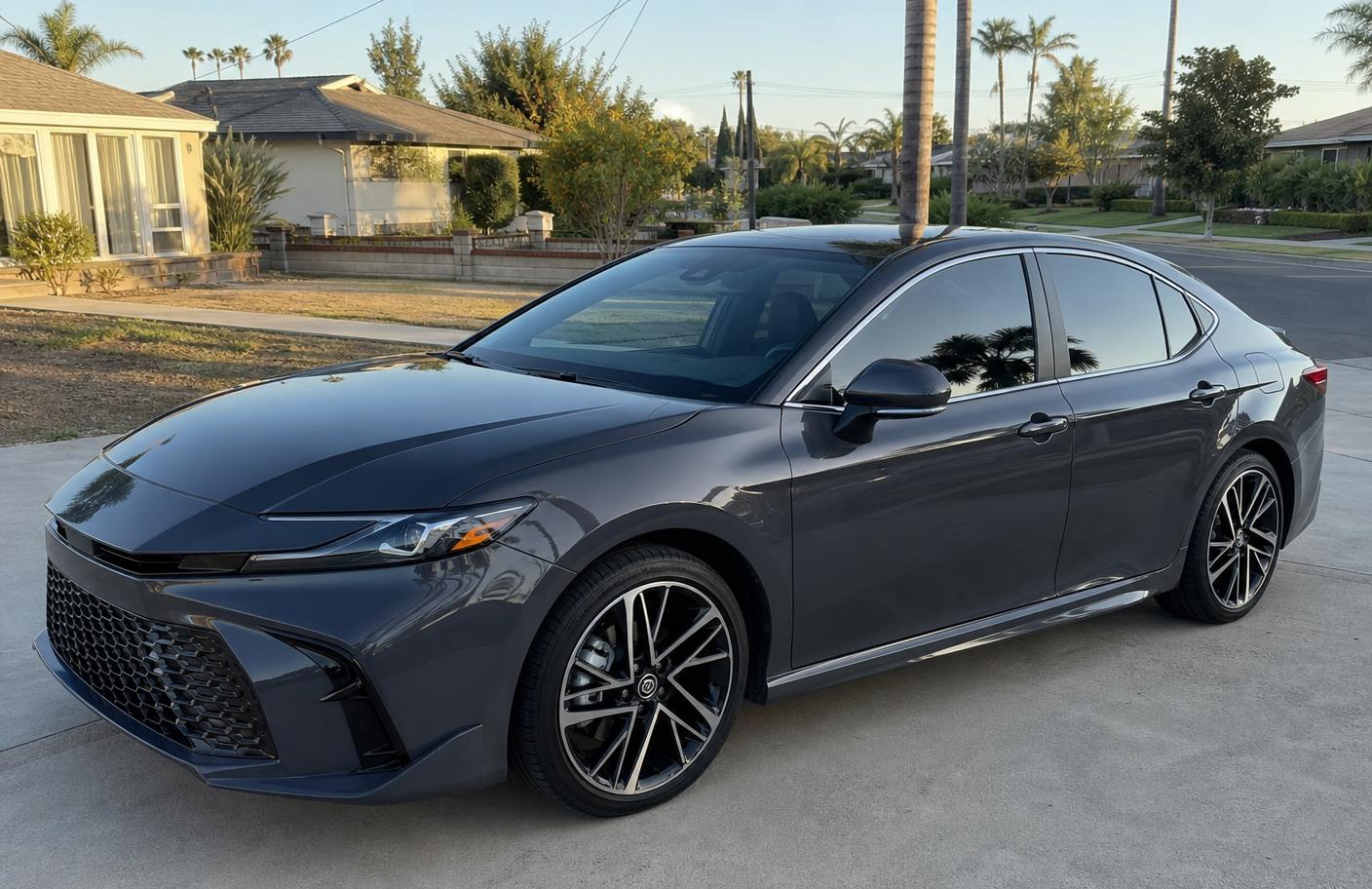
Black, dark blue, dark grey and deep metallic finishes are the most rewarding cars to correct — and the least forgiving of poor work.
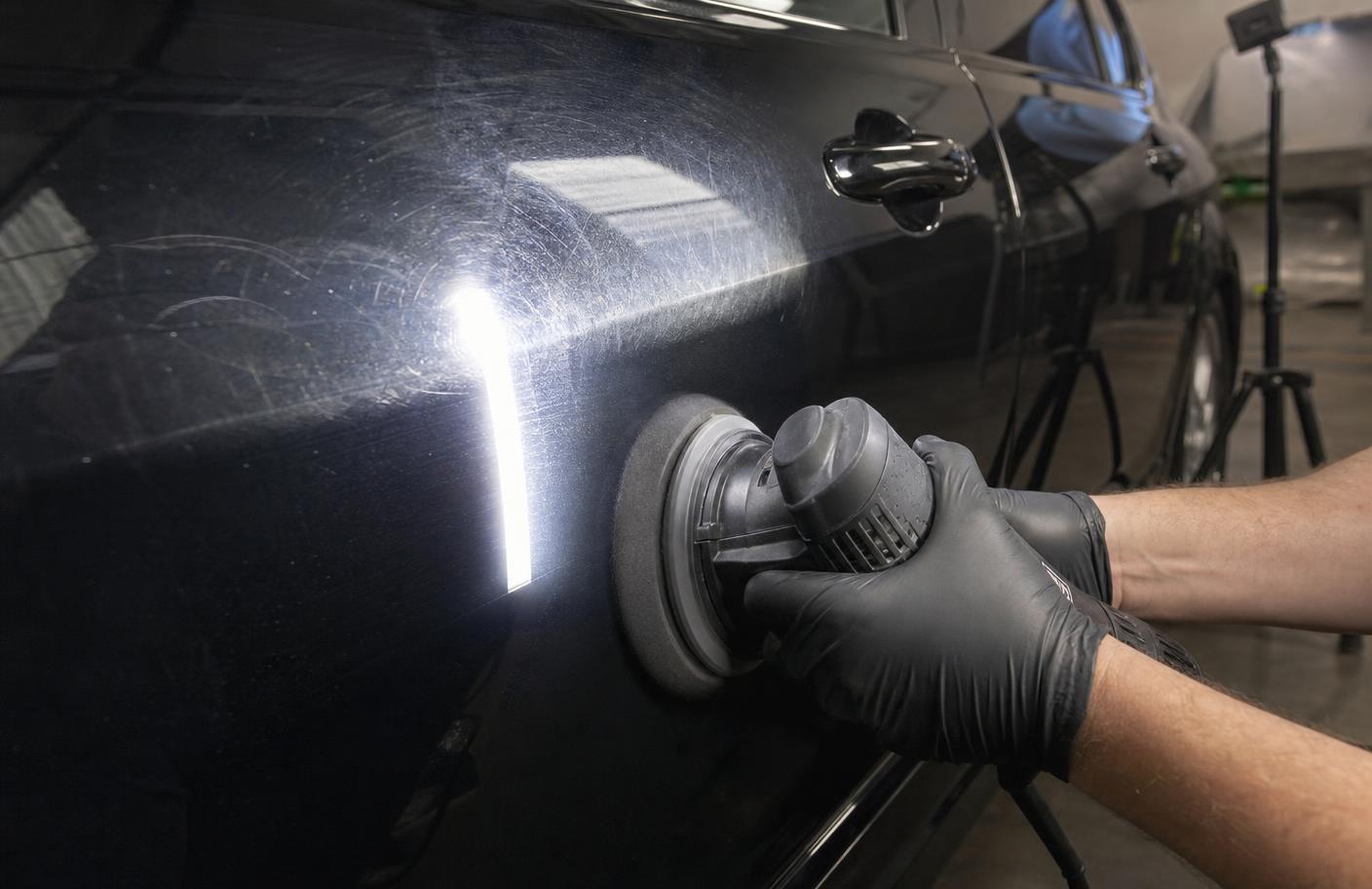
Dark paint reflects light more directly and has less visual noise to hide behind, so every swirl mark, hologram and patch of haze reads clearly in direct sun. The same physics that makes defects obvious makes a properly corrected dark car look extraordinary: reflections snap into focus and the color gains real depth.
Finishing quality is where dark paint separates competent work from careless work. A cutting pass that would look perfectly acceptable on silver will show as visible haze or buffer trails on black, so the refining stage is not optional. It is also why we inspect dark cars under several different light sources — LED inspection lights, ambient daylight and angled lighting each reveal different things, and paint that looks flawless under one can show marring under another.
Dark vehicles also show new wash damage faster than any other color, which makes aftercare especially worth taking seriously once the correction is done.
Paint correction for luxury and performance vehicles
A meaningful share of the correction work we do in Los Angeles is on vehicles whose owners simply care about finish quality: premium daily drivers, enthusiast-owned weekend cars, performance cars and long-term collector vehicles.
What those vehicles have in common is not badge value, it is expectation. Owners who have looked closely at their paint know what a hologram is, notice a hazy refining pass, and want the finish to look right under scrutiny rather than only from ten feet away. That means slower work, more inspection and a refining stage that is treated as essential rather than optional.
Practical considerations differ too. Garaged low-mileage cars usually carry fewer road-inflicted defects but more wash marring from well-intentioned frequent cleaning. Daily-driven premium vehicles carry the opposite mix. Older collector cars may have original single-stage paint or decades-old repaint work, both of which call for a far more cautious approach and a frank conversation about what is safe to attempt.
New vehicles can need paint correction too
A new car is not automatically a defect-free car. Paint accumulates marring long before delivery: dealership washes with shared media, contamination and film picked up during transport, weeks or months of lot storage in full sun, water spots from rinsing without proper drying, and sometimes a hurried machine polish applied before handover that leaves holograms behind.
That does not mean every new vehicle needs correction. Plenty arrive in genuinely good condition and need nothing more than decontamination. The honest approach is to inspect the paint under proper lighting and treat what is actually there.
Where new vehicles do commonly benefit is before protection. A light polish on a new car removes the handful of defects picked up in transit and at the dealership, and means the coating seals in clean paint rather than someone else's wash marks.
Paint correction before ceramic coating
A ceramic coating protects and seals whatever finish is underneath it. It does not fill, hide or correct defects — and because it adds clarity and gloss, it can make existing swirls and haze slightly more visible rather than less.
So if the paint contains swirl marks, haze, holograms, oxidation, water etching or light scratches, those should be evaluated before any coating is applied. Coating over them locks them in for the service life of the coating, and removing them later means polishing the coating off and starting again.
The natural sequence is straightforward: correct the paint to the level that makes sense for the vehicle, then protect the result. Correction restores clarity; the coating keeps maintenance gentle enough that the clarity survives.
Read the full detail on premium ceramic coating in Los Angeles, including what a coating does and does not do — or ask us to quote correction and coating together and we will scope the preparation honestly.
Paint correction vs polishing vs buffing
The terminology is used loosely in the industry, which makes comparing quotes harder than it should be.
"Buffing" is the vaguest of the three. Depending on who is saying it, it can mean a quick all-in-one pass that boosts gloss, a genuine correction, or an aggressive rotary job that leaves holograms behind. It is not automatically a filler-based shortcut — plenty of skilled work gets described as buffing — but the word alone tells you very little about what will actually be done.
"Polishing" describes the mechanical action, and it covers a range: a non-corrective gloss enhancement, a light defect-removal pass, or the individual stages inside a full correction. A polish can be corrective or purely cosmetic depending on the abrasive and pad used.
"Paint correction" should mean something more specific: deliberate, measured defect reduction through machine polishing, with the process chosen by testing and the result verified under inspection lighting after residues are removed. If a quote does not describe inspection, testing and a finishing stage, it is worth asking what is actually included.
Paint correction vs scratch removal
Whole-vehicle correction and individual scratch work overlap, but they are not the same conversation. Correction addresses the general condition of the finish; scratch work addresses one specific piece of damage that usually bothers the owner more than everything else combined.
What determines the outcome is depth. A scratch confined to the clear coat can often be leveled or substantially improved. One that has gone through the clear into the base coat cannot be polished out — the color layer is damaged and only paint work restores it.
The fingernail test is a rough clue rather than a diagnostic: if your nail catches in the scratch, it is likely deep enough that polishing will only soften its edges and reduce how much it catches the light. If your nail glides over it, there is a reasonable chance of meaningful improvement. Neither result is conclusive, which is why we assess scratches under inspection lighting before saying what is possible.
Sometimes the right answer is that a scratch can be improved but not safely erased, because removing it entirely would take more clear coat than the panel can spare. We will tell you that rather than quietly leveling the surrounding paint too far.
Paint correction vs oxidation restoration
There is an important line between paint that is dull and paint that is failing.
Oxidation is the surface degradation of the topmost layer under prolonged UV exposure — the chalky, faded look on a car that has spent years parked outside. Where that degradation is confined to the surface, polishing can often remove the oxidized layer and restore a genuinely surprising amount of gloss and color. Older single-stage paint in particular can respond dramatically.
Paint failure is different. Clear coat that is peeling, flaking, cracking or delaminating has lost adhesion, and no amount of polishing brings it back. Polishing failing clear coat generally makes it worse by thinning what little remains and lifting the edges of the failure. Restoring those panels requires refinishing at a body shop.
Telling the two apart is part of the inspection. If we find delamination we will say so plainly, even when it means declining the job — and where the failure is limited to one or two panels, correcting the healthy panels can still be worthwhile.
Mobile paint correction in Los Angeles
Correction is long, precise work, so the environment matters more than it does for a wash. We bring our own power, lighting and equipment, but the space itself has to support the job.
What a suitable location looks like: shade or an enclosed garage, because direct sun heats panels, makes polish flash too quickly and makes accurate inspection nearly impossible. Reasonable dust control, since airborne grit landing on a wet panel mid-pass creates the exact defects we are removing. Enough working clearance to move around all four sides of the vehicle with a polisher. Safe access to power. And a stable environment for an appointment that may run most of a day.
Situations that often need a rethink: uncovered street parking in full sun, very tight tandem spaces, active construction nearby, and exposed hillside or beachfront driveways on windy afternoons. Subterranean and structure parking usually works well, provided building management allows the work and there is room to open doors fully.
We would rather establish this before booking than turn up to a space that cannot support the work. Describe your parking situation when you request an estimate and we will tell you honestly whether correction is viable there or whether a different service is the better use of your money. The mobile detailing Los Angeles overview covers how appointments run in general.
How long does paint correction take?
There is no single answer, and any quoted duration given without seeing the car is a guess.
The variables are vehicle size and panel complexity, paint hardness, how severe the defects are, how many correction stages the job calls for, overall paint condition, whether previous polishing work has to be undone, and how far you want to take the result.
As a rough shape: a gloss enhancement or one-step on a mid-size sedan is often a single day. A genuine multi-stage correction on a dark car with hard paint can require two days or more, and large SUVs and complex body shapes add time. We give you a realistic range after the test section, once we know how the paint is actually responding.
Correction is not work that benefits from being rushed. We would rather book the right amount of time than compress a two-day job into one and finish with a haze that shows up in the first patch of sunlight.
How much does paint correction cost?
We do not publish fixed prices for correction, and we would be suspicious of anyone who does. The same nominal service on two cars can involve very different amounts of work.
What determines your estimate: vehicle size and panel count, current paint condition, defect severity and depth, the correction level you want, paint hardness and how quickly it responds, any repaint or previous correction history, the total time the job requires, and whether you are pairing it with protection afterwards.
A fixed sight-unseen quote either has to assume the worst case — pricing you above what your car actually needs — or assume the best case and then get revised upward on the day. Neither is a good experience. We look at the paint, run the test section, tell you what levels of improvement are available and what each involves, and let you choose.
Send us the vehicle, color, where it parks and a few photos in daylight, and we will come back with a realistic estimate and an honest recommendation about which level of correction makes sense.
Keeping swirl marks from coming back
Corrected paint is not immune paint. The defects we remove are gone, but nothing stops a brush wash next month from installing a fresh set. Correction removes existing defects; good maintenance is what prevents new ones.
- Avoid brush-style automatic tunnel washes and gas-station wash bays entirely
- Hand wash with the two-bucket method, a grit guard and a pre-rinse that removes loose grit before anything touches the paint
- Use clean, dedicated wash media and retire mitts that have been dropped on the ground
- Dry with fresh, plush microfiber or filtered air — never a shared towel from the garage shelf
- Never wipe a dusty car dry; dust plus pressure is exactly how marring happens
- Remove bird droppings, sap and mineral deposits promptly, especially on hot panels
- Book periodic maintenance detailing so contamination is dealt with safely rather than scrubbed off
- Protect the finish with a sealant or ceramic coating so washing needs less contact and less pressure
If you would rather not maintain it yourself, we run scheduled exterior hand wash and wax visits for corrected vehicles — or see all detailing services for the full list.
Related paint and finish services
Correction sits alongside a few other paint-surface services worth knowing about. If your finish feels gritty after nearby construction or painting work, that is contamination sitting on the clear coat rather than defects in it — see overspray removal, which should be handled before any polishing.
Oxidized, yellowed headlight lenses are a related but separate job with its own process; headlight restoration covers it. And once correction is complete, premium ceramic coating or a maintained hand wash and wax is what keeps the result intact.
Multi-Stage Paint Correction across Los Angeles neighborhoods
This service is booked most often in the areas below, where local conditions make it especially worthwhile.
- Paint Correction in Beverly HillsGarage-based detailing for luxury vehicles between Rodeo Drive and the flats.
- Paint Correction in BrentwoodDriveway and garage service across Brentwood, from the Village to the canyons.
- Paint Correction in Studio CityHillside and boulevard-adjacent detailing around Laurel Canyon and Ventura.
- Paint Correction in PasadenaHistoric-home driveways and Old Pasadena structures, with heat and tree care.
- Paint Correction in Manhattan BeachSalt- and sand-focused care for cars near Highland Avenue and The Strand.
Multi-Stage Paint Correction FAQs
Related services
- Premium Ceramic CoatingA durable, hydrophobic layer bonded to prepped paint — easier washing and stronger defense against LA sun and fallout.
- Overspray RemovalPaint, stucco and industrial overspray safely lifted off paint, glass and trim without damaging the finish.
- Headlight RestorationYellowed, hazy lenses sanded back to clarity and re-sealed with UV protection — a safety fix as much as a cosmetic one.
Back to all detailing services or the mobile detailing Los Angeles overview.